Showing posts with label Resources. Show all posts

Wednesday, September 5, 2012

Turn Your Photos into Oil Paintings

http://funny.pho.to/antique_oil_painting

Nifty site where you can upload images and turn them into realistic-looking oil paintings (amongst many other effects).

As you can probably tell, I've got too much time on my hands.  Monthly therapy was last week and I've been stuck at home for the few days needed afterward.

Nude gardening in my back yard
(wish there were a way to change where the reflection
would be but I do like the overall effect).

Weeding the rose plants

Hiking in the Cascade Mountains

Monday, September 3, 2012

How to Make a White Balance Adjustment to your Photos

I commented on a previous hike (and several other times) about adjusting the white balance of your images to get more pleasing results . . . especially of the skin tones.  Our eyes are remarkably flexible and nimble in interpreting lighting conditions to render what we see.  But cameras do not easily adjust necessarily the way we perceive things.  A picture taken in a room lit by an incandescent light bulb comes out with overly warm orange-casts while the same image under fluorescent  lighting may appear overly green.

Sometimes we want these effects . . . as in pictures taken during sunset for the vibrant red colors produced by ambient light that has taken the long way through the atmosphere and color-shifted down into the reds.  My favorite time to take pictures is in the late afternoon when the light from the sun is actually warmer (color-wise).

Getting out into the forests adds a slight wrinkle to photography . . . while the light from the sun may be good, it is reflecting endlessly back and forth off of a lot of green vegetation and leaves and that light is adding a slight green tinge to your photographs.  The same sort of thing would happen if you took a picture in the deep earthen tones of the badlands of Eastern Washington and wondered why everything took on a very 'tanned' look. What is needed is a way to shift the overall color-balance of the image back to "standard" sunlight . . . remove that greenish, or reddish or whatever tinge.  Adjusting the white balance during post-production is one easy way to take a major step in restoring what your eyes have seen.  I'm going to show you how to do that in two popular and free image editing programs . . . PhotoScape and G.I.M.P.

Both these programs are free and contain no annoying spyware.  PhotoScape is the easier to use while G.I.M.P. is a very powerful, almost clone of Adobe's expensive Photoshop.  Both will allow you to adjust the white balance of an image.

A Note on Image Editing:

The de'facto format for storing an image nowadays is the Jpeg format (the .JPG extension on your pictures).  JPeg is a lossy format, meaning that information is lost every time you edit and resave the image.  After a number of edits and saves a Jpeg image will begin to take on artifacts that degrade the image.  It usually takes quite a while for these artifacts to become noticeable so you want to make ALL your edits at one time before you save the finished image . . . or save the interim image in a non-lossy format such as BMP or TIFF.  Needless to say, use SAVE AS with a different file name rather than SAVE so that you always have the original image to start over with.  PhotoScape makes this easy as it saves the originals into another folder automatically for you.

A Reference to Something White

The camera doesn't know what is pink or green or blue or white.  It only knows about the color temperature of the light reflecting off of objects in your image . . . even if that reflected light has had a lot of green added from bouncing around in the forest canopy.  But if we have something showing in our images that we know the color, we can use that as a reference to simultaneously correct all the other colors throughout the image later.  White is the best choice since white is a combination of all colors and the easiest to use as a reference.

The white reference I most often use are my white socks (since I'm a nudist and rarely wear much of anything else).  It could be a white hat or something as simple as a white piece of paper or an index card placed somewhere in the image where it can be cropped out later.  In the images used as examples below I used a pair of white socks carried in my fanny pack as a white reference.


Adjusting White Balance in PhotoScape

From the publisher of PhotoScape:

PhotoScape is an all-in-one style photo editor with fun and ease of use. Major capabilities are: viewer, editor, batch editor, page, combine, animated GIF, print, splitter, screen capture, color picker, rename, raw converter, resizing, brightness/color/white-balance adjustment, backlight correction, frames, balloons, text, drawing pictures, cropping, filters, red eye removal and blooming
PhotoScape is free and can be downloaded here.


Before adjustment
Adjusting the white balance of an image is simple within PhotoScape.  Click the drop-down arrow by 'Bright,Color' and select 'White Balance'.  Note that there is also a shortcut key combo to accomplish the same thing . . . 'CTL-W'.  A dialog box comes up with instructions.  The box can be dragged out of the way if necessary.

After Adjustment
Find something white in the image and hover the cross-hair cursor over it.  Click to see the changes the program will make.  If unsatisfied you can click in a slightly different area.  When satisfied, click 'Yes'.  Make any other adjustments you may want and then save the image.  Make sure you select the 'Make backup copy ...' during the save dialog.


Adjusting White Balance in G.I.M.P.


GIMP is an acronym for GNU Image Manipulation Program. It is a freely distributed program for such tasks as photo retouching, image composition and image authoring.
It has many capabilities. It can be used as a simple paint program, an expert quality photo retouching program, an online batch processing system, a mass production image renderer, an image format converter, etc.
GIMP is expandable and extensible. It is designed to be augmented with plug-ins and extensions to do just about anything. The advanced scripting interface allows everything from the simplest task to the most complex image manipulation procedures to be easily scripted.

GIMP has been described as the open-source version of Adobe's Photoshop, and like Photoshop, there is a steep learning curve to getting the most out of GIMP.   GIMP is sometimes slow and quirky in Windows (mainly because it was developed for the open-source community comprised mainly of Linux users and there have been a lack of dedicated Windows developers for GIMP).  However, the power of GIMP far surpasses the minor glitches that sometimes pop up.  GIMP can be downloaded here.

Before Adjustment
Within G.I.M.P. with your image opened,  select 'Colors' and then 'Levels' to open the Levels dialog.  This dialog can be a little intimidating but we are only interested in three buttons with eyedroppers near the bottom  . . . Black Reference, Grey Reference, and White Reference (Hint: Hover the cursor over each button for Tool Tips description).  Since white is the most common reference available in an image, click the outermost button,  Make sure the 'Preview' checkbox is selected.

After Adjustment
Moving the cursor over the image will change the cursor to a color-picker eyedropper.  As with PhotoScape, click in a known white area to preview the changes.  It not satisfactory, click a different area.

 G.I.M.P. saves in it's own proprietary lossless format, which is fine if you want to make changes in the future.  To save to the more common JPEG format you choose to 'Export' the image under the 'File' menu.

G.I.M.P. also has a handy facility to aid in post-production composition of your images . . . Guides:

Golden Means Gridlines overlain on the image.
Note how the axis of the torso is directly on one of the grids?
I've alluded to Golden Sections and composition before.  This handy facility aids you in cropping your images so that your subjects are situated in the most pleasing compositional arrangement.  Whenever you select or use the crop tool (it looks like a scalpel in the toolset), you have the option to overlay a grid over the selected area of the image.  Select a grid (or guide) from the dropdown box to the bottom right.  The goal is to crop (or move) your image so that the subject falls on one of the intersection points of the lines . . . or on the line, itself.

Saturday, September 1, 2012

The Perils of Clothing

When I was much younger I used to suffer all the time from skin rashes . . . from the simple heat rash variety to some pretty annoying allergic reactions with accompanying hives.  As a teenager living in the foothills near San Diego, California I had my first brush-up with Poison Oak and that episode left me with a complete rash from the soles of my feet to the top of my scalp.  We visited a 'witch doctor' in Escondido who gave me a shot of poison oak extract and advised my parents to scrub my body daily with lava soap.  I suffered through two weeks of agonizing itching, soreness and dehydration as my skin weeped and glued bed sheets to my body.  My mother told me years later that they really thought I was going to die . . . such was the condition I was in . . . and yet, they trusted the doctor . . . who were they to tell him otherwise?.  The only positive outcome of that episode is that now I appear to be essentially immune to reactions from the poison oak varieties . . . not that I tempt fate by wandering through thickets of poison oak just for the heck of it (nude or otherwise.)

Year later I discovered that I was allergic to Neomycin after suffering the classic signs of a traveling rash that itched like crazy and then produced a case of monster hives on my chest.

Forward a little bit after that and I was visiting doctors to deal with prickly heat rashes that perfectly matched the outline of my underwear . . . later to learn that I was now somewhat sensitive to good-ole friendly laundry bleach . . . a product that has been banned from my washing machine ever since.

Soooooo . . . what has this got to do with nudism and naturism?  Glad you asked.

A couple of days ago I got home from work and stripped as soon as I was in the door (first item to come off, the watch . . . I never feel nude if I'm still wearing a watch) . . . heading for some sun in the backyard.  While sitting there soaking in the rays I contemplated my feet . . . very often not free when I hike nude because of the necessity to be prudent and protect the feet tasked with getting me safely home.  A picture should do to illustrate:

After  day of having to wear shoes
How pitiful they looked!  Red, sore, hot . . . the weave of socks deeply imprinted within the skin for hours to come.  Contrast that with the healthier skin of an upper thigh that sees a lot of sunlight and fresh air:

The skin of my upper thigh is vibrant and responsive . . . it feels alive!

Days later I got to thinking about aspects of driving nude and just why I do it.  There is one part of my body that is extremely sensitive to the 'kiss' of sunlight and breeze upon it (no, it's not that) and that is a band of skin roughly analogous to the lower waistline . . . specifically a band a couple of inches wide running from the protuberance of hip bone to hip bone.  Doesn't matter that everything else could be covered by a teeshirt or a towel across the lap . . . this band of skin responds sensuously to any light breezes or the warming rays of sunlight upon it.  It is also unfortunate that the seat belt also runs across this area and I have a habit of adjusting the belt higher just to keep the skin underneath exposed and free.

It would be my educated guess that, like my poor feet and the shoes we must wear, this area suffers from the predilection in our society towards skin-squashing elastic briefs and trousers and belts that do a major disservice to the aliveness of the skin beneath.  We do not allow it to breath, we trap the sweat up against it for long hours at a time . . . we slowly poison our own skin.

I tan reasonably easy . . . not a deep tan, just a good coloration reflecting my Mediterranean heritage.  However there is one part of my body that never seems to take on a tan very easily and . . . you guessed it . . . it is that one band of skin running from hip to hip.  I have to wonder if all those years of tight jeans have actually crippled the ability of that skin beneath to respond as it was designed to do so.

Skin rashes are what got me into nudism in the first place . . . under orders from a wise old Dr. Marcus, MD-style practitioner who suggested I find a quiet, secluded spot in my backyard and catch some rays on my skin to help clear up my 'pelvic' rashes . . . which meant nude, of course.  And that therapy worked marvelously . . . better than any stinky cream or ointment available at exorbitant prices at the pharmacy.  On top of that very painless medical therapy it is also very pleasant and calming.  If only all medical procedures were this enjoyable!  Now I free the largest sensory organ of my body every chance I can get to give it a dose of fresh air and natural sunlight as possible.

If there was ever an argument for NOT wearing clothes, the health of the skin is got to be near the top of the list.

NAC Action Alert - Seattle, WA


**********************************************************************
                     NATURIST ACTION COMMITTEE
                           ACTION ALERT
**********************************************************************
                   http://www.naturistaction.org
**********************************************************************
Copyright 2012 by the Naturist Action Committee, which is responsible for its content.
Permission is granted for the posting, forwarding or redistribution of this message,
provided that it is reproduced in its entirety and without alteration.

DATE       : September 1, 2012
SUBJECT : Seattle Parks Survey
TO           : Naturists and other concerned citizens

Dear Naturist,

This is an Action Alert from the Naturist Action Committee. NAC is asking you to participate in the ongoing effort by naturists and others to establish an officially recognized clothing optional beach in Seattle, Washington.

A MESSAGE FROM NAC BOARD MEMBER MARK STOREY

A skinny-dipper friend of ours has pointed out to me that Seattle Parks & Recreation has a new online survey out. While taking it, I found three opportunities to say that I favored Seattle Parks’ establishing a clothing-optional beach. This is an easy opportunity for naturists and their allies to speak up.

Please take the five minutes needed for the survey, and be nice. When the Naturist Action Committee and the Body Freedom Collaborative met with Parks officials not long ago, officials made clear to us that they needed to know that there were actually a large number of people interested in nude beaches. Here's a chance to move in that direction. People living in and near Seattle, WA are especially encouraged to take the survey, but others can, too.

The survey is at the following URL:

     http://seattleparkssurvey.com/SPR1/SPR1logn.htm

NAC NEEDS YOUR HELP TO CONTINUE HELPING NATURISTS!

The Naturist Action Committee works for the clothing-optional recreational use of public land. To do its job, NAC relies entirely on the voluntary generosity of supporters like you.

Please take a moment to send a donation to:

   NAC
   PO Box 132
   Oshkosh, WI 54903

Or call toll free (800) 886-7230 to donate by phone using your MasterCard, Visa or Discover Card. Or use your credit card to make a convenient online donation:

http://www.naturistaction.org/donate/

Thank you for choosing to make a difference!

Naturally,

Bob Morton
Executive Director
Naturist Action Committee

---------------------------------------------------------------
Naturist Action Committee (NAC) - PO Box 132, Oshkosh, WI 54903
Executive Dir. Bob Morton       - execdir@naturistaction.org
Board Member Mark Storey        - storey98@aol.com
Online Rep. Dennis Kirkpatrick  - naturist@sunclad.com
---------------------------------------------------------------


Monday, August 20, 2012

Article: Sun exposure: Benefits beyond D production


Here is what we know, sometimes incompletely, about the effects of sun exposure on the human body:
1. Enhances mood and energy. Generally, a little bit of sun exposure is associated with better mood, while tanners commonly report feeling more relaxed than non-tanners. One study demonstrated that β-endorphins increase after sun exposure, which would explain this association. Three studies found no increase in β-endorphin production after sun exposure, but the authors speculate that the anxiety from a blood draw to check on endorphins would negatively affect endorphin levels.
2. Treats skin diseases. These diseases include treatment of lupus vulgaris, psoriasis, vitiligo, atopic dermatitis and localized scleroderma. Why phototherapy works in the treatment of these diseases is not completely understood (usually broadband UVB or narrow-band UVB, but sometimes UVA also), researchers do know of some mechanisms during phototherapy. UV radiation reduces the rate of cell proliferation in the skin, activation and proliferation of melanocytes, reduction of T-lymphocytes, and reduction of Langerhans and mast cells.
3. Relieves pain in fibromyalgia. Sunbathing seems to have potential to reduce pain in patients with fibromyalgia compared to no exposure. The mechanism is unknown.
4. Skin barrier functions. Skin exposed to UVB and UVA is more resistant to primary irritants. Once again, the mechanism is unknown.
5. Protects from disease beyond vitamin D? In an animal model, researchers discovered that sun exposure is more protective and suppressive against multiple sclerosis than just vitamin D alone.
6. Induces nitric oxide. UVA exposure induces nitric oxide (NO*) production. It has been suggested that NO* protects the skin for 20-30 minutes from UV damage, offers cardiovascular protection, helps wounds and have some anti-tumor activity.
One area that the authors did not mention was melatonin regulation. It is believed that the more light one is exposed to during the day, the sooner melatonin production occurs at night. Melatonin is involved in the sleep-wake schedule and when released, makes the body drowsier and cooler.
While there is much work to be done in the realm of figuring out specific mechanisms of action induced by UV exposure, we have some clues as to what sun exposure accomplishes outside of vitamin D production.

Thursday, June 28, 2012

Vlog - Online Photography & Nudism

An interesting YouTube video discussion of nudism and the posting of nude photos on the web.


Perspective in your Photos . . . Include Yourself

... or more specifically, a good reason to include yourself in your photos of all those great places you visit.
Perspective refers to the relationship of imaged objects in a photograph. This includes their relative positions and sizes and the space between them. In other words, perspective in the composition of a photograph is the way real three-dimensional objects are pictured in a photograph that has a two-dimensional plane. In photography, perspective is another illusion you use to produce photographs of quality composition. From the U.S. Navy Photography Training Course

In this image of L-Chute waterfalls on the Tye River there are
few clues to the size, scope and the majesty of these falls.
When we view landscapes with our two eyes we are experiencing the scene stereoscopically (a slightly different image seen in each eye).  We render the landscape in 3D, drawing conclusions about depth, distance and relationships from those differences..

When we take that same image with our cameras, the result is two-dimensional and our only clues to spatial relationships are drawn from the compositional perspective either intentionally or unintentionally within the image.  That is why close up images of things like the waterfalls above, often fail to convey and impact the viewer on the depth and distance of objects experienced by actually being there and seeing it with your own two eyes.

A slight shift of camera position to include foreground objects
and the photographer establishes greater depth and perspective.
In the second image I moved the camera back slightly to include a few moss-covered boulders and myself.  Since most people are 5-6 feet tall (I'm six foot even), the viewer's eyes now have information to gauge the apparent size of these waterfalls.  Instead of a flat image of a landscape, there is depth and unseen, but imagined, lines of perspective to a vanishing point along which the elements of the image establish themselves.  The image conveys a lot more information.

With an abundance of bright areas in the image, the center-weighed metering of most digital cameras would underexpose the foreground.  Use of the fill-in flash and a little post-production enhancement to reduce backlighting helps to use the gradations of lighting on my torso also as clues to perspective (i.e., I appear to stand out in the image because of the lighting).

So . . . do you now have that excuse to include yourself in the pictures of your nude adventures?

Saturday, April 21, 2012

Use High Ground to Your Advantage

One of the greatest boons of hiking nude in the Cascade Mountains (or anywhere, for that matter) is that you develop an increased awareness of your surroundings and what is going on. Naturists and nudists immerse themselves into their surroundings much more so than the typical, destination-oriented hiker. We drink the tactile sensations of sunlight, breeze, etc. impinging on the greater-exposed surface of our skin . . . the largest sense organ by far, we smell much more acutely as we synthesize everything in our environment to add to the experience, we hear not just the surroundings but a cacophony of clues to guide us. And our eyes become exquisitely acute . . . sensitive to the slightest movement.

Not to say that this is anything unique to nudists . . . I've just found that my senses are much more acute and encompassing when I'm open and have imbued essentially part of the environment I'm within. I attribute this continuous epiphany to hiking nude. Our senses of the environment are simply much more receiving and open.

Of course, part of this increased awareness is due to our need to co-inhabit the wilderness with those who may take exception to our hiking nude (the paranoia factor) . . . something that is always in the back of our mind when we strip down nude with the knowledge that we just may encounter other hikers on the trail. Though I espouse a 'grin and bare it' attitude in general . . . if I do have advance knowledge of approaching hikers I will often don shorts out of respect for potential negative attitudes (unless I am really deep in the wilderness where few care one way or another).

Using the high ground to your advantage is one way to keep yourself involved in what is happening around you. Humans have exquisite binocular vision but unfortunately mentally 'see' in the horizontal . . . a result of our evolutionary development from a foraging species. There is one climaxing scene to the original Star Trek movie where the Enterprise and the ship commanded by Khan are waging battle in a sensor-inpenetrable gas nebulae. Khan is winning, the Enterprise already crippled  . . . Khan hot on Kirk's trail. Kirk is unable to shake Khan. But Khan is a twentieth-century man used to waging battle on a planetary surface . . . two dimensional. Kirk, on the other hand, 'flies' star ships in outer space, a three-dimensional environment. In the blind environment of that nebulae he moves the Enterprise vertical and out of the perception of his pursuer. Khan simply cannot envision anything but what is directly in front of him. He blazes blindly ahead only to have the Enterprise suddenly drop back down and behind him for the killing shot.

Little does Khan realize that Kirk is now behind him
and about to finish it off.
(Poster from Star Trek: The Wrath of Khan)
 When we taught air combat tactics during the Vietnam 'conflict' we emphasized thinking in three dimensions (energy maneuvering). Those of you who have been involved in air-combat understand this potential blindness of an adversary fresh out of flight training. Many more examples could be cited from submarine tactics to simply holding Pork Chop Hill as the high ground.  Humans think two dimensional and rarely note what is above or below us. We evolved on the flat plains of the Serengeti. Our threats did not come from above but rather from the two-dimensional grasslands around us.


The Mountain Goat's horizontally-slitted
eye pupil gives greater visual acuity in
vertical field of view.
Our eyes (with round pupils) have evolved binocular and peripheral vision sharpest above all in what is before and around us. We do not forage nor hunt in the vertical, unlike goats with their horizontally-shaped pupils that allow them a greater depth perception to threats or food on the slopes above and below them. I have often stood on a trail high on a slope and watched approaching hikers for a long time, only to have them notice me only when they turn a switchback and then bring their eyes to bear on the trail in front of them for the next leg. Rarely do they scan the trail above . . . they only see what is in front of them, often only where their feet are stepping.

With the high-ground I can see incoming hikers long before they will see me.
(image taken on FS6028 during a conditioning nude hike April 20th, 2012)


The gist of this little piece is that you can (and should) use high ground to your advantage. Think not only in the two-dimensional, but also in the vertical third dimension to be aware of what might be coming your way.  Look up once in awhile.  You may see me up there watching your approach like a predator.  :-)

Wednesday, March 14, 2012

Article: Nudity Is Healthy for Brains and bodies

http://ieet.org/index.php/IEET/more/pellissier20120314

Hank Pellissier
Ethical Technology

Posted: Mar 14, 2012


Is clothing crushing us? Are we trapped in tomb-like textiles, exiling our flesh from experiencing the environment? Are we atrophying our epidermis, our senses, our neuro-intelligence?
 
If you put a plaster cast on a broken arm the skin starves for Vitamin D, the muscles weaken due to strangled range of motion, the nerve synapses depress to a whimper of their former joy. Twenty-first century hominids? We shroud our entire skin palette except for face, neck and hands - we obliterate symbiosis with the planet.


We hide in cocoons, when we could be free as butterflies.
History reveals many cultures that were not clothes-minded. Spartans were basically bare and their victories in pan-Hellenic sports competitions enticed all neighboring Greeks to exercise nude, creating the word “gymnasium” (Greek gymnos = naked). Romans mingled in magnificent bathhouses, enjoying dense communal nudity as they drank, dined, defecated, bathed, read books, argued politics, and watched theater.  Adamists — naked heretics — performed stripped-down church services in North Africa, Bohemia, the Netherlands, and England. Pre-Hitler Germans were avid adherents of Freikorperkultur (“Free Body Culture”) with 70,000 attending co-ed Nacktkultur schools.

There’s naked Japanese in hot springs, naked Finns in saunas, “sky-clad” Jain monks in India, plus millions of nudists worldwide going to “Nakation” camps, beaches, and resorts. They’re still sporty as Spartans, eager to hike naked (“free bush rambling”), canoe naked (“canuding”), bicycle naked, ride horses naked, run naked, play volleyball, badminton, ping-pong and chess naked, swim naked, dance naked, do Naked Yoga, Naked Tai Chi, Naked Gardening, Naked Bowling, and of course, many of us, perhaps you and I, dear readers, are NIFOC — Naked In Front of Computers.

Many famous figures were bare-all aficionados; too many politicians to name, so I’ll just list sci-fi and scientists: Leonard Nimoy, Alexander Graham Bell,  Robert Heinlein, and seismologist Charles Richter. Nudism is prominent in Philip Jose Farmer’s Riverworld books and John Varley’s Steel Beach. Celebrities? Many movie stars skinny-dip at the French Riviera, trying to elude paparazzi seeking pix of Bruce WIllis’ willy or Natalie Portman’s port side.

Here’s evidence suggesting that skin-only can be superior:

Born Free.  Pediatricians agree that infants thrive with a daily dose of “naked time” because the unhampered range of motion aids brain development, stimulating neuron growth. Recent discoveries reveal that the “plastic” brain changes and develops throughout our entire lives. Neuroplasticity pioneer Michael M. Merzenich believes,  “Everything that you can see happen in a young brain can happen in an older brain.” Doesn’t this imply that “naked time” is equally valuable for humans of any age, especially the elderly?

Weakened Bodies. A 2003 University of Reading study entitled “A Naked Ape Would Have Fewer Parasites” posits that “humans evolved hairlessness to reduce parasite loads, especially ectoparasites that may carry disease.” Unfortunately, the garments we wear can be a breeding ground for filthy fungi and bad bacterium, causing yeast infections, urinary tract infections, rotting toenails. Lyme Disease deer ticks can grab onto our sweaters and sea lice can sneak into our bathing suit crotches. Cinched-up belts, ties, and clothes impede breathing. Men’s snug pants raise testicle temperature, lowering sperm count and fertility.


Barefoot Medicine. Going shoeless is now recognized as an anti-Alzheimer’s, brain-boosting activity because the sole sensation entices your brain into growing extra, efficient neuron connections. Dr. Norman Doidge (author of The Brain That Changes Itself) believes skipping shoes increases brain flexibility and youthfulness, and many podiatrists now advise going barefoot as much as possible. Bare feet are today’s prescription. Will tomorrow’s elixir take the next step: Bare Body?

Superior Socialization. Self-actualization proponent Abraham Maslow believed “Nudism… is itself a kind of therapy.” Health benefits of social nudity include stress reduction, satiation of curiosity about the human body, reduction of porn addiction, a sense of full-body integration and developing a wholesome attitude about the opposite gender. Research at the University of Northern Iowa discovered that nudists have significantly higher body self-acceptance. Another study concluded that teens at a New York nudist camp were “extraordinarily well-adjusted, happy, and thoughtful.” It’s also excellent for children to grow up free of shame about the human body.

Tolerant Views.A University of Central Florida 2008 study of 384 participants concluded that pro-nudity students “were significantly more accepting of other religious groups and gays and lesbians” when compared to the anti-nudity students. They were also “less prejudiced towards ethnically dissimilar others.”

Soothe Away Your Crazies. Massage is recognized as a therapeutic treatment for mental health issues like depression, anxiety, schizophrenia, bipolarism, borderline personality disorder, learning difficulties, and low self-esteem. The skin stimulation of massage — improving blood flow and detoxifying the lymph system — is duplicated by the warmth, freedom, and improved circulation generated in nakedness.


Soak Up The Rays Vitamin D deficiency is currently soaring, with up to 75% of USA teens and adults receiving insufficient amounts of the “sunshine vitamin.” Lack of this essential health aid is a factor in numerous ailments, including cancer, heart disease, osteoporosis and diabetes. Anyone who bares all outside as a “naturist” harvests larger amounts of Vitamin D in a quicker time span.

Financial Liberation. Clothes are a huge money and time-suck with shopping, laundry, closets, dressers, and gazillions of hours wasted wondering what so-and-so looks like with their garments removed. The global markets for swimsuits alone is expected to reach $17.6 billion annually by 2015; our carbon footprint would shrink like a wool sweater if fabric was no longer manufactured.

Longevity (just joking!). Have you noticed that the furry Norway Rat only lives 2-3 years, while the Naked Mole Rat survives to be 28?
So… is the future going to be full frontal? Will the post-Singularity planet be stripped? Will everyone in a climate-controlled tomorrow choose to be nude, strutting around like the Nuba dancers and boxers of Leni Reifenstahl?

Trends point to an era where there won’t be a stitch to worry about. Many resort areas are are now offering nudism to increase tourism, and American naturist clubs claim their enrollment is growing 20% annually. The German airline OssiUrlaub.de offered nude chartered flights to a Baltic sea resort, and today’s lengthy luggage searches at airports are steering travelers to destinations where they only need carry-on towels and sunblock. Twenty million Europeans already go to nude beaches and spas.
Getting goosebumps imagining it, are you?

Hank Pellissier, the IEET's Managing Director, is the author of two e-books Why is the IQ of Ashkenazi Jews so High? - scientific factors that influence intelligence, and Invent Utopia Now: Transhumanist Suggestions for the Pre-Singularity Era

Sunday, November 28, 2010

Cold Weather Nude Hiking (Repost)


Be Prepared When Nude Hiking in Cold Weather

Originally posted Thursday, January 17, 2008


A repost of this article for the upcoming cold weather die-hard . . . wish I was amongst you


36 degs F. and comfortable
I've gotten a few emails from readers wanting to get out there and hike nude in the snow. For most of us the mere thought of getting naked in near-freezing weather does not sound like very much fun, but I can assure you that the human body is very much capable of dealing with cold weather and the experience can actually be very comfortable, serene, invigorating and freeing. You just need to take some commonsense precautions. If that weren't enough to get you out there, trails and routes that are otherwise too popular or overrun by textiles and families in the warmer months are often all yours with nary another soul to bother you (heck, the lack of tracks in the snow tells you no one is on the trail ahead of you!)

Perhaps I should call it "nude backpacking" as opposed to nude hiking or free-hiking. During the warmer months on shorter day routes I prefer to hike with the least amount of covering possible (a hat, hiking shoes and a fanny pack slung over my shoulder . . . sometimes absolutely nothing at all.) I've been known to take all my clothes off, stack them neatly and wander off completely naked as the day I was born. One writer describes that type of exercise as an epiphany for the now, newly converted nudist. You will never want to hike in any other form . . . except when the weather requires it.

In winter (or any weather that is likely to turn inclement) you'd be foolish to hike without the essentials to insure your survival should things go wrong. One reader commented on the size of my backpack, asking how much it weighed. Well, it does look big on my back but if you pack judiciously a 'survival' pack could weigh in about 15-25 lbs which is easily carried in a well-balanced backpack. For me, the most cold-sensitive portion of my anatomy is my back . . . a cold chill down the spine can instantly send me into shivers. Since the pack sits slung over my back I tend to stay warm in that area.


"Clothing" for when you need to warm up

Look at what it takes to keep you warm, dry and comfortable while standing in the snow next to your car at the trail-head and that is what you need to carry with you in your backpack. I pack (after I undress, no need to duplicate):
  • Thermal, wicking undergarments (remember, no cotton; it gets wet or soaked from perspiration and you freeze),
  • Two extra pairs of wool socks and an extra pair of wicking undersocks,
  • Wool Sweater (tight-weave, thick fiber has the best insulating properties and insulates even when wet),
  • Snow pants (insulated, the type you'd wear skiing or snowboarding),
  • Your windproof, water-resistant outer-shell parka,
  • A second pair of snow gloves or mittens,
  • A small towel to dry yourself off with should you get wet.
I carry these items in a 45-gal 3mil black plastic trash bag (the contractor cleanup type) stuffed back into the pack to keep them dry. The trash bag can serve double-duty as something to sit on, on wet ground or snow, an emergency shelter or as an impromptu poncho by poking three holes in the bottom and pulling it down over your head and arms. I also carry a second trash bag in the pack. Pack your clothes near the top where you can get at them easily should the weather get ugly or you need to warm up. A little trick . . . activate one or two of those foot or hand warmer packets and fold your inner clothes around them to keep them nice and warm for when you do need them.


Food

Food is an essential even if you are only going on a four-hour day hike. What would happen if you got lost or were forced to weather out a sudden snowstorm. I carry the following supplies in a separate ditty bag in the backpack:
  • 9- Top Ramen (easy to prepare comfort food to warm your soul, body and spirit),
  • 3 foil-sealed packages of tuna (for protein), one of the cellopaks of saltine crackers from the 4-pack boxes, an assortment of individual-serve mayo, relish and salt and pepper packs shamelessly stolen from BurgerKing,
  • 9 hot chocolate singles, baggies of instant coffee, creamer and sugar, a few plastic spoons and forks,
  • 4-5 large bars of chocolate; full of slow burning fats and sugar energy . . . the hikers friend and an essential when you are burning large amounts of calories to maintain your body temperature,
  • My whisper stove and a few canisters of butane (above 5,000 I would carry a multi-fuel stove as butane doesn't work very well at altitude),
  • My trusty GI-mess kit,
  • The fire kit: A good supply of waterproof, strike-anywhere matches (make your own, coat matches in paraffin and store in a waterproof container. Add a striker surface (emery board, small piece of sandpaper). Add a 30-hour candle or two, a magnesium striker and tube of fire-starter paste and you should be able to light a fire in pretty much any situation.
I don't expect to have to dig into the food bag on a day hike. It's there on the off-chance that I'm going to have to survive on my own for a couple of days . . . and yes, I have. I overextended myself on one hike into the Glacier Wilderness, running out of daylight to the point where I had to stop and make camp out of my emergency supplies. It can (and will) happen.

I always practice bear-protocol, even when any sensible bear should be hibernating in winter. The food bag has a 50 ft length of strong nylon cord inside that can be used to raise it up out of bear reach. The cord would come in handy for a lot of other uses, as well.


Paraphernalia in the Outer Pouches

In the outer pouches of my pack I carry the paraphernalia of modern society. The most important one a First Aid Kit. The first aid kit doesn't have to be elaborate but should have a few hiker's-essential supplies like moleskin for blisters, band-aids, ointments, gauze pads, some safety pins, etc. to cover the typical scrapes and bruises all hikers get. I carry the old style styptic pencil that shaver's use to use to stop minor scratches from bleeding. A small roll of duct tape in the pack along with a couple of emergency mylar space blankets cover many other potential repair and emergency situations.

I carry my cell phone, my camera and my GPS unit when I hike. When I hike with friends I also like to hike with a set of FRS radios to stay in contact. I also carry one of those neon headlamps for nighttime use. All of these require batteries. You should have a set of backup batteries for all items and you should try to keep these batteries protected from the cold. Cold drains a battery in half the normal time.

In another pouch I carry my maps and charts, compass and a few other essential items.

My Bear Deterrent spray and my hunting knife seem to permanently be on the belt of my backpack. I leave them there . . . never had to use the spray.

On the back rigging I carry a small, collapsing snow shovel.


Water

While it may seem that with snow all around there is no need to carry a lot of water, dehydration is a serious problem for cold-weather hikers . . . and even more for nude, cold-weather hikers. Very cold air is also very dry air, as moisture condenses out with dropping temperature. That dry air sucks moisture from your skin and breath very efficiently. Constant hydration is very important. So three important points:
  1. Carry plenty of water and be prepared to obtain more. My backpack has a three-liter hydration bladder built into it, which is normal enough for the typical day hike. A hose snakes out of the top of the pack within easy reach to draw a sip on. I also carry a Sweetwater Filter to filter water from opportune sources along the trail. Try to avoid eating snow to hydrate yourself as all you're doing is lowering core body temperature to melt that snow. The hiker's rule-of-thumb for sufficient hydration is that if you are urinating clear you are sufficiently hydrated.
  2. Your exhalations are the largest source of dehydration in cold weather. Just look at your breath and see all that moisture condensing to a fog. You should avoid breathing through your mouth in cold weather . . . your nostrils are far more efficient at retaining body heat and moisture. Cold weather often induces a stuffy nose so carry decongestants in your first aid kit.
  3. Your skin transpires as much water out of your body in cold dry air, as it does trying to stay cool during hot weather. You lose both water and body heat. An answer I've found is that if your keep your skin moisturized ahead of time you will feel a whole lot warmer and less chill-bound (a sign that your skins is transpiring moisture). Take care of your skin and it will take care of you. Moisturizing your skin also makes it somewhat water-repellent . . . melted snow flakes and rain will ball and roll off your skin quickly without wetting large areas. Remember, water conducts heat away 50 times more efficiently than air.

    When I shower I liberally moisturize myself with simple ole baby oil . . . mineral oil. You can find fragrance-free baby oil if the aroma seems too childish . . . doesn't bother me. The treatment makes my skin feel alive and aware. Prior to a hike I rub in some of the leftover suntan lotion I always seem to accumulate in squeeze tubes in my car. The lotions have an efficient moisturized content as well as the UV-protection . . . which mustn't be forgotten, even in winter.

What this Nude Hiker typically wears on a cold weather hike

You've got your backpack set, you've reached a spot where you feel the desire to be free of the bulky clothes and hike naturally. Put as much attention to undressing and packing for need as you did for the rest of your supplies. Despite how careful I try to be, I have fallen through weakened snow-bridges on several occasions and appreciate being able to find dry clothing quickly in my backpack to warm up. Set your pack down where it won't get wet or tip over and carefully undress and fold your clothes in a logical order . . . the order you'd want to retrieve them in a hurry. The last item to come off should be your top . . . gives you a chance to acclimatize yourself to the sudden cold, which is a shock to everyone. You will quickly warm as your metabolism kicks into higher gear.

With my clothes packed safely away and the backpack slung over my back, this is what I'm typically wearing from top on down:
  • A knit wool cap (60% of your body heat is lost through the top of your head; more for balding people like me. That is a fact . . . wear a hat!),
  • Sunglasses on a retainer around my neck. Snow blindness is not fun! Get a good pair of mountain glasses,
  • The pack on my back. I typically do not belt mine as the weight is easy to carry and I enjoy the extra skin exposure,
  • My thermos in a water-resistant carrier bag looped over head and shoulder. I either fill mine with hot chocolate or coffee. Coffee is a no-no, as it's a diuretic but I love my coffee,
  • My digital camera attached to a very light-weight collapsing tripod slips into the side rigging of my backpack. With exposed metal surfaces, try coating with the plastic dip used for tools. Helps to prevent cold-contact discomfort when you have to handle those metal surfaces,
  • Gloves. Mine are thermal Thinsulate gloves which convert to mittens easily yet give the dexterity of a warm glove. Fingers, poorly supplied with blood, are quickly affected by the cold,
  • Two pairs of socks (an inner wicking pair under woolen hiking socks) keep your feet warm and dry, and resist blisters as the two pairs slide against each other rather than your feet,
  • A good pair of leather hiking boots . . . pre-worked in and treated with water-repellent. The tongue should be continuous to keep out snow and moisture. Choose hooks rather than eyelets for the top to make tying easier with cold hands. The boots should also have the heel catch for use with snowshoes,
  • Over the boots I wear calf-covering gaiters to keep snow off my lower legs and out of the top of my boots. The REI branded ones I bought have a reflective insulating inner surface that keep my lower legs and feet toasty warm,
  • Snowshoes (mine are Denali Evo Ascents). Don't skimp. These are what keep you up above the surface of the snow instead of post-holing to your crotch with every step. Choose snowshoes designed for your weight and the type of terrain you typically hike in (flat, alpine) . . . and for the weight of the snowshoes. Technical use of snowshoes is beyond this article. Learn to use them ahead of time . . . it's not that hard,
  • Poles. Forget expensive trekking poles unless they already have snow baskets. I use my ski poles.

Hypothermia

Acclimatization to cold weather is a 'learned' response over time. The Inuit of the arctic have a markedly lower core body temperature to what we consider normal (95F to our 98.6F) and have tuned their basal metabolism and circulation to be as efficient as ours at this lower temperature. They can withstand cold temperature far more efficiently than us 'southerners' can.

The metabolic response to temperature changes is a complicated one. Simply stated, we, as warm-blooded beings, can only burn fuel (food) for cell energy within a narrow range of temperatures . . . the core body temperature. Our body will go to great biologic and physiological extremes to maintain that core body temperature. Understanding this metabolic response is important to knowing your limitations and the dangers hypothermia represent . . . especially to a nude hiker totally exposed to the elements. Acclimatization increases your metabolic efficiency and allows you to stay warm for longer periods of time. Remember, clothing does not warm your body . . . clothing simply reduces the loss of body heat. Any and all heat you experience (short of warming yourself by a fire or slipping into a hot spring pool) is generated by your metabolic processes burning the fuel (the food your eat) into energy. Know the signs of hypothermia and your limits:
  1. Your skin tightens upon exposure to cold; body hairs stand on end to more effectively trap an insulating layer of air next to the skin,
  2. Blood vessels initially dilate under the exposed skin surfaces, warming the skin and giving the rosy-cheeks syndrome. As more heat is lost, this process shuts down;
  3. Goosebumps forms and tiny, consciously-controllable shivering may commence;
  4. The skin becomes a pasty white . . . chalky in later stages; blood supply to shell skin areas and extremities is reduced. Shivering becomes more intense as the body fights to maintain the inner core temperature of the internal organs and the brain. You are entering Stage 1 Hypothermia;
  5. Arterial shunting reduces blood flow to the extremities, leading to cramping and uncoordinated use of leg and arm muscles. Shivering become continuous, tiring and intense. You are in Stage 2 Hypothermia and need to preserve the remaining body warmth before you lose the ability to act;
  6. Violent, uncontrollable shivering ceases as the body preserves even this expenditure of scarce energy to keep the heart, lungs and brain warm and functional. You are disoriented to the point of not even being aware of the cold, tired and wanting to sit down and sleep. You are in Stage 3 Hypothermia and in a medical emergency. Your body is losing it's ability to produce heat and will slip rapidly into a fatal coma.
Know the progression and signs. Shivering is normal . . . violent shivering that is impairing and beyond your control is a serious warning sign that you've passed your limits.

Acclimatization to Cold Weather


Acclimatization is the increasing of your body's heat-production and retention efficiency. As you slowly expose yourself to cold weather in longer increasing periods your body responds by burning foods more efficiently. As we go into spring and summer and are no longer exposed to these colder patterns, we acclimatize in the other direction, slowing the efficiency down to maintain that 'normal' 98.6F core body temperature. Vitamin B6 is an excellent supplement to increase the efficiency of our metabolism and I take it regularly in the colder months of the year as I'm working my naked body to withstand and enjoy nudity in the cold. Omega-3 fatty acids are not only good for your cholesterol levels but induce a high level of cold resistance. Get them through eating cold-water fish like salmon or taking flax seed oil capsules.

The key is to acclimatize over time. Do not shock your system by heading out on a long nude snow hike without some period of adjustment to your system.

When exposing you body to cold weather . . . particularly when you must be able to keep yourself warm without the insulating-crutch of clothing . . . eat easily digested foods such as carbohydrates and sugars; adding smaller amounts of fat and protein to balance the digestive load. Digestion consumes up to 30% of all available energy after a large meal. That's energy not available to keep you warm. Avoid large and heavy meals full of protein and fats immediately prior to a hiking expenditure. Carb-load the night before and keep your trail eating to small and frequent snacks.
  • Sugars are the high-octane fuels and produce a quick burst of energy and a falloff just a quickly.
  • Carbs are more complicated sugars (starches and such) that burn slower and over an extended period. Carbs are the basic sources of energy to fuel metabolism.
  • Fats (such as chocolate) are an excellent source of stored energy that can be called on as the body needs. However, if you don't use fats, guess where they go? Don't go overboard on fats as a high-fat diet takes weeks to adapt to and can lead to abdominal stress; something you don't need on the trail. However, fat reserves within the cells of our body are very important both during the acclimatization phase and when the body calls on energy reserves to bolster core temperatures and maintain glucose levels.
  • Proteins are the structural components for the body. However, in need, proteins are metabolized (burned) for heat energy because they produce a large amount of heat. However, they are difficult to digest and leave many undesired byproducts when burned for fuel . . . such as salts which will lead to increased urination and dehydration.

Control heat loss at the vulnerable points. The head, which loses 60% of all body heat through the scalp (the seat of our intelligence is in the brain and the brain requires a huge amount of energy to function.) Likewise, wear good boots to keep your feet warm and wear gloves. The under-supplied toes and fingers quickly go numb and useless in cold weather.

My back is decidedly sensitive to a cold-shiver, and I suspect that's the case with most of us. Cover your back in some manner (coat slung over the shoulders, backpack, in my case). Our nipples (in both men and woman) suffer painfully when it really gets cold. Likewise the genitalia, particularly men, will feel the painfully numbing cold eventually. Recognize what's happening and don't suffer needlessly. The layering principle applies to nude hikers as well . . . except we might need to put on that first layer as needed.

It is often said that women, with typically thicker subcutaneous fat layers, are better able to withstand the effects of cold weather . . . and that makes sense as adipose fat is a great insulator. You only need look to the ability of marine mammals with their thick blubber to withstand the numbingly frigid waters of the Arctic. But what I've noticed is that the same insulating nature of adipose has a rebound effect . . . those same layers of fat become cold reservoirs and resist warming up or letting external heat through after a hike. I noted that effect several years ago after a challenging nude snow hike that I pushed despite the winds and snow turning ugly. Once back in my car with the heat going full blast, much of my body quickly warmed up . . . except the areas where adipose fat underlay my abdomen and 'love-handles' (yeah, I got lazy that year and let my spare-tire get ahead of me.) Those areas of my body stayed icily-cold for the next few hours despite clothing, heat and a general rewarming of the rest of me. The fat was a great insulator but insulation works both ways! The upshot, some body fat is okay but a lot of adipose can become a liability if you push the limits of your cold exposure.

A note on frostbite . . . can't get it unless the ambient air or wind-chill temperature is below freezing. The laws of thermodynamics plainly state that you can not reduce the temperature of an object below the ambient environment . . . except under certain, unique circumstances . . . supercooling. Supercooling happens under high wind, high humidity conditions. Don't hike nude in such conditions . . . please. Even I'm not that stupid and will put on clothes when the wind picks up much beyond 5-10 mph. When it is below freezing your extremities (particularly toes and fingers, and since we are nude, the nipples and genitalia) are very susceptible to damaging frostbite. Watch for painful, chalky white skin progressing into a lack of pain as frostbite happens. Don't let it get this far!


Last Thoughts

Did I forget anything? I'm sure I have.

While I enjoy endless roaming around the mountains nude in the balmier months, taking off my clothes in a wide-open and pristine snowfield and hiking free is a unique and almost spiritual experience. Also, while I consider hiking nude in the snow a personal challenge, I temper it with the realization that I have to be aware of how my body is responding. But what else is a nudist good for than being aware of his or her body interaction with the environment. We nude hikers know how sublime the experience is . . .

Monday, October 11, 2010

Photographic Composition . . . a la' Nude

Feel free to Download the eBook of this post, 2.5M, pdf format for easy reading. Freely re-distributable under the Creative Commons License (Attrib NC ND)


"If you, an artist, the one who cannot manage figures, 

you look like an orator who cannot manage words." 

Leonardo da Vinci


A photograph is a story.  It is intended to impart information . . . experiences . . . emotive feelings.  Nude photography could be generalized into that which is intended to evoke a sexual response (pornography) or that which depicts the nude human body in our everyday natural environment (what I call 'simple nudity' . . . sharing the nudist lifestyle through my photographic journeys).

Like a story . . . a collection of words and sentences strung together in some coherent form . . . a photographic image is a collection of visual elements that convey what your eyes see.  It is the balance and composition of your image that determines the first impression viewers have of your photos.   Good composition draws your viewers eyes (and attention) to certain parts of the image.  Balance assures that the viewer's attention is not drawn away by extraneous details.

Centrally placed subjects tend to focus a viewer's attention on the middle of the image. Unfortunately, once a viewer's attention is on the middle, it usually remains there. As a result, a picture of this type will tend to feel flat and static to the viewer. However, with just a subtle shift of the focal point toward one of the intersections defined by the Rule of Thirds (discussed below), you can strengthen your image and cause the viewer's eye to move more freely around the image.

Good composition places the important elements off-center

"Rules" of composition are based on ratios almost always seen in nature.  Leonardo da Vinci recognized these ratios as did Michelangelo . . . and both applied them in their awe-inspiring works of art.  This same symmetry and ratio is what makes the human form pleasing to the eye (look at the statue of David and ask yourself why it draws you).  Artists and photographers have instinctively applied and extended these ratios to their works with great viewer satisfaction since ancient times.

This short tutorial will focus on a few simple "rules" of composition that, for the most part, become instinctive in your future picture-taking once you recognize how composition affects a viewer's impression.


The Rule of Thirds
"One third is important, one third continues, the last third places"
Banged Up Shins

The objective of the Rule of Thirds is to stop the subject(s) and areas of interest from bisecting the image, by placing them near one of the lines that would divide the image into three equal columns or rows . . . ideally near the intersection of those lines.  The Rule of Thirds is based on the tendency of the viewer's eyes to be initially be drawn about two-thirds of the way up whatever they are viewing (be it a page of type, an oil painting or a photograph.  Our minds will divide and ingest by thirds, initially focusing two-thirds of the way up and then internally scanning the other elements in steps of thirds over the image.  The center of any image is the least important part unless other elements draw attention and focus there (as we'll see later.)

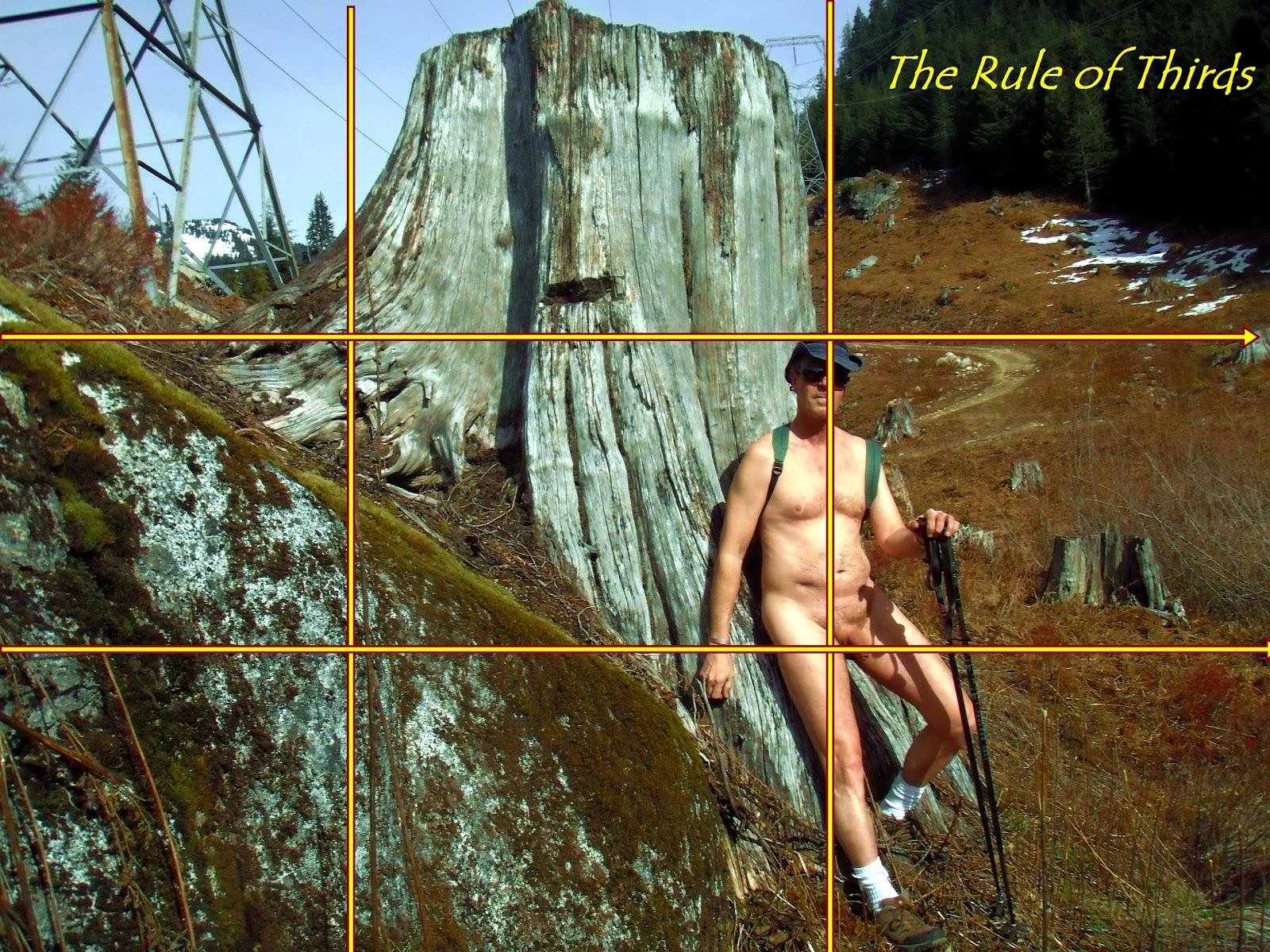
If we mentally cast a grid of thirds over a scene (my camera makes this easy as I can call up a grid in the viewfinder), we want to compose the important parts of our image at the intersections of the grid lines or on the grid lines, themselves.  In the image below, my head is two-thirds of the way up the image at the intersection of two grid lines.  The viewer's focus and attention are automatically going to be drawn to my head and then mentally form a response in relation to all the other elements in the image using that ratio of thirds.

Rule of Thirds
Note that a pleasing depiction of the human body in relation to the background will conform to the ratio of thirds.  Attention is drawn to the head at two-thirds of the way up.  The third above places the subject (myself).  The next third is the torso and the final continues and completes with the legs.  The axis of the body is also on a grid line, reinforcing the importance of the main subject  . . . in this case, I wanted to depict myself nude next to the stump of an old, massive and long-gone tree.

Placement of elements on the horizontal grid lines works well for horizons . . . in this case, the horizon beyond is all in the upper third . . . as is the majority of the tree stump.  The mind's eye is taken on a journey from the main subject and placed it in relation to the other important elements in the image.


So the Rule of Thirds in utter simplicity:  place your main subject off-center!


The Rule of Diagonals

Elements of your image trending diagonal (like a road or river . . . perhaps a line of trees) tend to lend energy to the imagery.  The image becomes more dynamic because the viewer is expecting action of some sort to go on.
Rule of Diagonals

Using the same image as before, the main subject is balanced by the Rule of Thirds.  But this image also contains a number of diagonals that impart a sense of tension in the image.  That tension is the terrain and there is an implied dynamism between nude hiker and steep slope.  Will he fall . . . or will he stay in place (note the set of the trekking poles reinforcing perceptions)?

To be effective, diagonals, when extended to the image edge, should be within 1/6 of the image corners (as shown in the image above.)  The dominant diagonal in this image is the slope of the large block of granite upon which the tree stump (and myself) hold against gravity.  My left knee is also crooked, bringing the thigh into alignment with the main diagonal.  The main subject, myself, is within one-sixth distance of a center diagonal.


Diverging and Leading Diagonals

Diverging Diagonals imply inclusion:  The tilt of the subject along with
 the lines of the boulders  frame the river beyond, including them
with the main subject

Leading Diagonals:  In this image, the subject (set back) is implied to be moving
 across the snowfield by the diagonal line of footprints leading back to the viewer.

To add dynamism to your images, place your subjects along some naturally-occurring diagonal.  Diagonals . . . particularly if they include the main subject . . . work really well if they lead to one of the corners of the image . . . a satisfying arrangement for the viewer's mind. (For another slant, take a look at the construction of the Golden Triangle further down to get an idea of the psychological processes that are operating here with diagonals.)


Lines of Perspective and Converging Diagonals

Diagonals impart action in an image.  Converging diagonals can also imply direction and perspective . . . a go hither implication.

Lines of Perspective

In this image the main subject's head (me, of course) is right at the intersection of two Golden Section lines (described in the next section).  These intersections, derived from the Golden Section ratio, assure attention from the viewer.  There is a slight twist of the torso and shoulders in the direction I am traveling.  I wanted to impart somewhat of a journey on ahead in pleasing surroundings.  Converging diagonals toward the open space of the sky give perspective and an implication of 'that's where I'm going'.  The diagonals come from the lines of the path edges and flow naturally to the far distance.  Tall trees in the upper portion of the image frame the sky of the horizon and the route beyond.

Look for these naturally-occurring lines in your images to reinforce the story you are telling.  Shift camera position slightly if necessary to use converging lines in the terrain to add perspective to your image.


The Golden Section
"A mathematical proportion where the ratio between a small section and a larger section is equal to the ratio between the larger section and both sections put together, approximately 1.6180339887..."

Certain points in a picture's composition automatically attract the viewer's attention.  Similarly, many natural and man-made objects with certain proportions (whether by chance or design) automatically please us.  Leonardo da Vinci investigated the principle that underlies our notions of beauty and harmony and called it the Golden Section.

The Golden Section (or Golden Mean) is the basis of the Rule of Thirds . . . the later being a simplification and easier to implement.  The intersection points for the Golden Section are 3/8s in and 3/8s up and down in the image.  I'll leave it up to you how to figure out the sweet spots when you're out on the field trying to compose an image.  Suffice it to say, the resulting grid looks as it does in the image below.  Points where lines intersect automatically draw attention . . . in this case, directly to the image of myself.

The Golden Section
Composition using the Golden Section ratio is difficult in the field but can be of considerable use after-the-case when cropping to bring the important parts of an image onto an nexus (or intersection point).  In the image above, there is implication of movement forward and to the right (raised foot taking a step).  The shadow line on the grass in the background also forms a diagonal, further reinforcing a perception of movement.  The effect is lost in the original image as objects to the right disrupt the diagonals and take away the dynamism of the image.  Cropping the image to remove extraneous detail moves the subject out of the Rule of Thirds and closer to the center of the image.  However, with a little judicious placement of the subject on a Golden Section nexus, balance is restored to the image.

Addendum:  To emphasize just how powerful the Golden Section intersections are, several readers have noted that their viewing of the above image seemed to unconsciously bring their initial attention to the area of my right hip.  I tried this on a few nudity-accepting acquaintances minus the grid and asked them, in all honesty, what part of my body did they seem to be drawn.  Mind you, these are people who have seen me nude before so there is no snapping of the viewer's attention to the obvious details of my nudity.  Five of five all stated the snap-response was to focus on the area near my right hip for a briefest moment, looking for something prominent there before correcting slightly upwards. The nexus of two Golden Section lines had drawn all five automatically.  Two of my unwitting test subjects also commented on the small log to the left, even though it was insignificant in the scheme of things . . . except that it also sits near an intersection of lines.

The eyes are drawn away  from the subject to the specks of light to the left
in the darkness  . . . a Golden Section intersection.   Though unintentional
 at the time, one wonders if those specks are some wild animal waiting
for dinner . . . an uneasy prospect!
The image above has the supposedly main subject (me) right in the center of the image . . . right where I just told you not to place your main subject.  So what's happening here?  Why do I include it?

Actually, the compositional elements of this image are complex.  Common sense tells us the nude hiker in the center must be the main subject (and that was the intention when I took the picture).  Serendipity at work.  There are some diagonals (the footpath and the darkness-bracketing line of the small tree) that enclose and direct attention.  There is also the stark contrast between flash-lit foreground and absolute darkness that further tell us who (or what) the main subject should be.  Yet our attention is not fully on the nude hiker.  It strays somewhat uneasily to the darkness.  Why?  Spend a little time just looking at the image.  Where do your eyes unconsciously go?  I'm willing to bet it's that lone tall plant sticking up into the darkness on the left.  And then your eyes search for meaning and latch onto the unusual . . . the set of what looks likes eyes out there.

This is a good example of the power of the Golden Section rule to grab and hold our attention.  The plant is right smack dab on the intersection of two of those lines.  Anything at those nexus points is going to grab the viewer's attention and this is what is happening here.


The Golden Triangle

The Golden Triangle adds an element of dynamism to the Golden Section rule by running diagonals to the intersecting points.  An offshoot of the Golden Section, the nexus points primarily attract the viewer's attention while the diagonals from those points extend attention along them.

The image below of me skinny-dipping in the Skykomish River is complicated by a lot of things taking place . . . cluttered.  My face (as well as my left hand) are right on the intersections of Golden Section Lines and thus, automatically attract attention.  But look at where the diagonals of a Golden Triangle flow . . . down my arms, framing my water-treading body in the lower triangle.  Attention is focused.  The final diagonal brings the foaming water to the right into harmony with the rest of the image.

The Golden Triangle

Constructing the Golden Triangle
.... from the Golden Section

Composition in the Field

It's obvious I take most of the images of myself using a self-timer.  This gives me time to frame the image and consider where I want to be for best composition.  I look through that viewfinder for lines and symmetry and mentally place myself where I think the Rule of Thirds will emphasize how I fit into the surroundings.

One of the things I try to do when composing an image, is to try to provide scale for the viewer to get an idea from the limited field of view in a photographic image . . . what the eyes are seeing.  An image is two-dimensional, yet what is being experienced is a three-dimensional panorama.  We must provide cues to the majestic scale of the forests and mountains to truly capture them.  The best way is to include yourself in the image not only to vet that participation but to also to give the viewer scale and enhance a 3D effect.

My presence gives scale and depth to the trees
on this low knoll overlooking Deception Creek

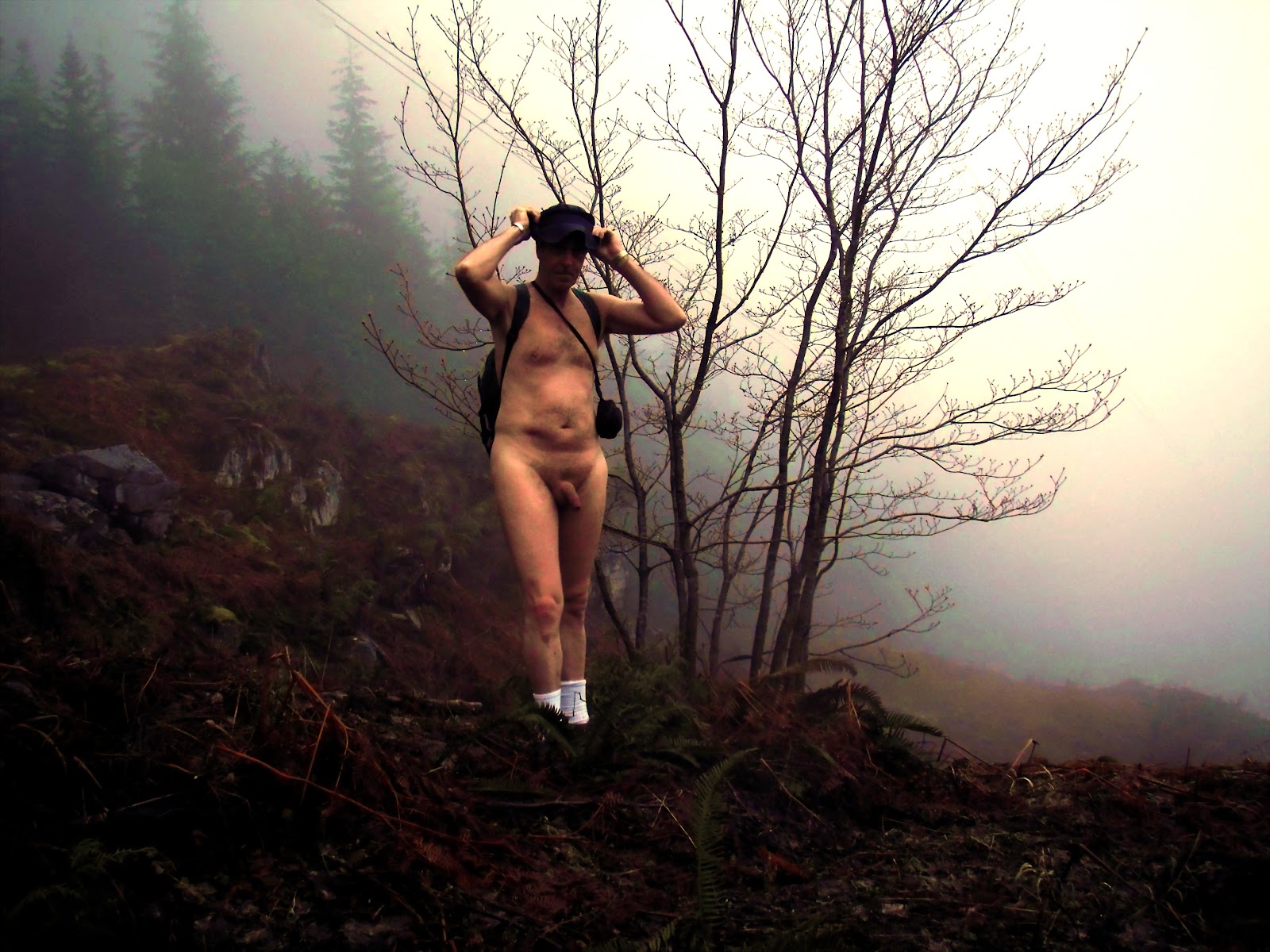
Another way to give the viewer an idea of the scale of the scenery is to use atmospheric cues such as fog.


The viewer's mind is always intrigued with figuring out what lays just beyond perception.  In the image above the fog does a remarkable amount of obscuring the trees in the upper left.  Our minds are going to be trying to pierce that veil trying to see through the fog . . . what does lay beyond?  Try it.  I challenge any reader to not honestly admit that they did not spend any time at all trying to pick out details in the background.

There is also an interplay of hard and soft contrasts in this image with the delineating line a diagonal crossing the image behind the main subject . . . the lone leafless tree in the center.  My presence provides the necessary scale and a contrast in color to make this image a keeper.

Try to avoid thinking of it as portrait photography because it isn't.  You are participating in nature and your images should show that participation.  You are, after all, trying to tell a story.

Final Thoughts 

  • There should be a center of interest or focus in the work, to prevent it becoming a pattern in itself;
  • The direction followed by the viewer's eye should lead the viewer's gaze around all elements in the work before leading out of the picture;
  • The subject should not be facing out of the image;
  • A moving subject should have space in front;
  • Exact bisections of the picture space should be avoided;
  • Small, high contrast, elements have as much impact as larger, duller elements;
  • The prominent subject should be off-center, unless a symmetrical or formal composition is desired, and can be balanced by smaller satellite elements
  • The horizon line should not divide the image in two equal parts but be positioned to emphasize either the sky or ground; showing more sky if it is of clouds, sun rise/set, and more ground if a landscape


Download the eBook of this post, 2.5M, pdf format for easy reading. Freely re-distributable under the Creative Commons License (Attrib NC ND)

Related Posts with Thumbnails