Thursday, October 21, 2010

Happy Halloween

Maybe you'll see me . . . maybe you won't.  This nude hiker is rarely seen, even in the wilds.  But I'm harmless (LOL).
Seriously, though.  I'm not out there to be seen.  I'm out there to enjoy nature in the most comfortable, enjoyable way possible.  That few ever see me is just a testament to the way I hike . . . quietly and with respect for others. Share the trail with us . . .  Better yet, join in and hike nude.

Monday, October 18, 2010

Nudism Central . . . what a pitiful disappointment!

Once promoted as clean, wholesome with no
adult-oriented content is now a sham

I have a few banners in the sidebar of this blog . . . linking to sites I believe advance the understanding of nudism and naturism.  Some time ago I was asked to place a link or banner to Nudism Central . . . advertised as completely free of any adult-oriented content (i.e. porn).  Checking out the site it seemed content was appropriate, so I place their banner in the sidebar as an option for those seeking nudist information.

On a lark today I clicked that banner and was taken to the site.  What used to be a promising start has almost completely turned into a nudist dating site . . . the questions asked could not be interpreted otherwise.  You have to sign up (supposedly free but I didn't continue through) and have to answer questions like "I am looking for ..."  'Totally free to place profile' is a typical piece of bait on these dating sites.  In order to meet a match I assume you'd have to pay money.  A dating site!

Okay.  Fine.  Not my cup of tea.  Not something I really wanted to promote on my blog.

I wondered if there was any useful nudist content on this site so clicked on the browse link at the top . . . and was taken to NudismTravelNetwork . . . which has absolutely nothing to do with nudism.  The entry page states quite explicitly :  "18+ WARNING:  This is a 100%  sex site" . . . and yes, it is.

So . . . their banner is gone.  NudismCentral has gone commercial, intrusive and a promoter of pornography.  Goodbye ...

Monday, October 11, 2010

Photographic Composition . . . a la' Nude

Feel free to Download the eBook of this post, 2.5M, pdf format for easy reading. Freely re-distributable under the Creative Commons License (Attrib NC ND)


"If you, an artist, the one who cannot manage figures, 

you look like an orator who cannot manage words." 

Leonardo da Vinci


A photograph is a story.  It is intended to impart information . . . experiences . . . emotive feelings.  Nude photography could be generalized into that which is intended to evoke a sexual response (pornography) or that which depicts the nude human body in our everyday natural environment (what I call 'simple nudity' . . . sharing the nudist lifestyle through my photographic journeys).

Like a story . . . a collection of words and sentences strung together in some coherent form . . . a photographic image is a collection of visual elements that convey what your eyes see.  It is the balance and composition of your image that determines the first impression viewers have of your photos.   Good composition draws your viewers eyes (and attention) to certain parts of the image.  Balance assures that the viewer's attention is not drawn away by extraneous details.

Centrally placed subjects tend to focus a viewer's attention on the middle of the image. Unfortunately, once a viewer's attention is on the middle, it usually remains there. As a result, a picture of this type will tend to feel flat and static to the viewer. However, with just a subtle shift of the focal point toward one of the intersections defined by the Rule of Thirds (discussed below), you can strengthen your image and cause the viewer's eye to move more freely around the image.

Good composition places the important elements off-center

"Rules" of composition are based on ratios almost always seen in nature.  Leonardo da Vinci recognized these ratios as did Michelangelo . . . and both applied them in their awe-inspiring works of art.  This same symmetry and ratio is what makes the human form pleasing to the eye (look at the statue of David and ask yourself why it draws you).  Artists and photographers have instinctively applied and extended these ratios to their works with great viewer satisfaction since ancient times.

This short tutorial will focus on a few simple "rules" of composition that, for the most part, become instinctive in your future picture-taking once you recognize how composition affects a viewer's impression.


The Rule of Thirds
"One third is important, one third continues, the last third places"
Banged Up Shins

The objective of the Rule of Thirds is to stop the subject(s) and areas of interest from bisecting the image, by placing them near one of the lines that would divide the image into three equal columns or rows . . . ideally near the intersection of those lines.  The Rule of Thirds is based on the tendency of the viewer's eyes to be initially be drawn about two-thirds of the way up whatever they are viewing (be it a page of type, an oil painting or a photograph.  Our minds will divide and ingest by thirds, initially focusing two-thirds of the way up and then internally scanning the other elements in steps of thirds over the image.  The center of any image is the least important part unless other elements draw attention and focus there (as we'll see later.)

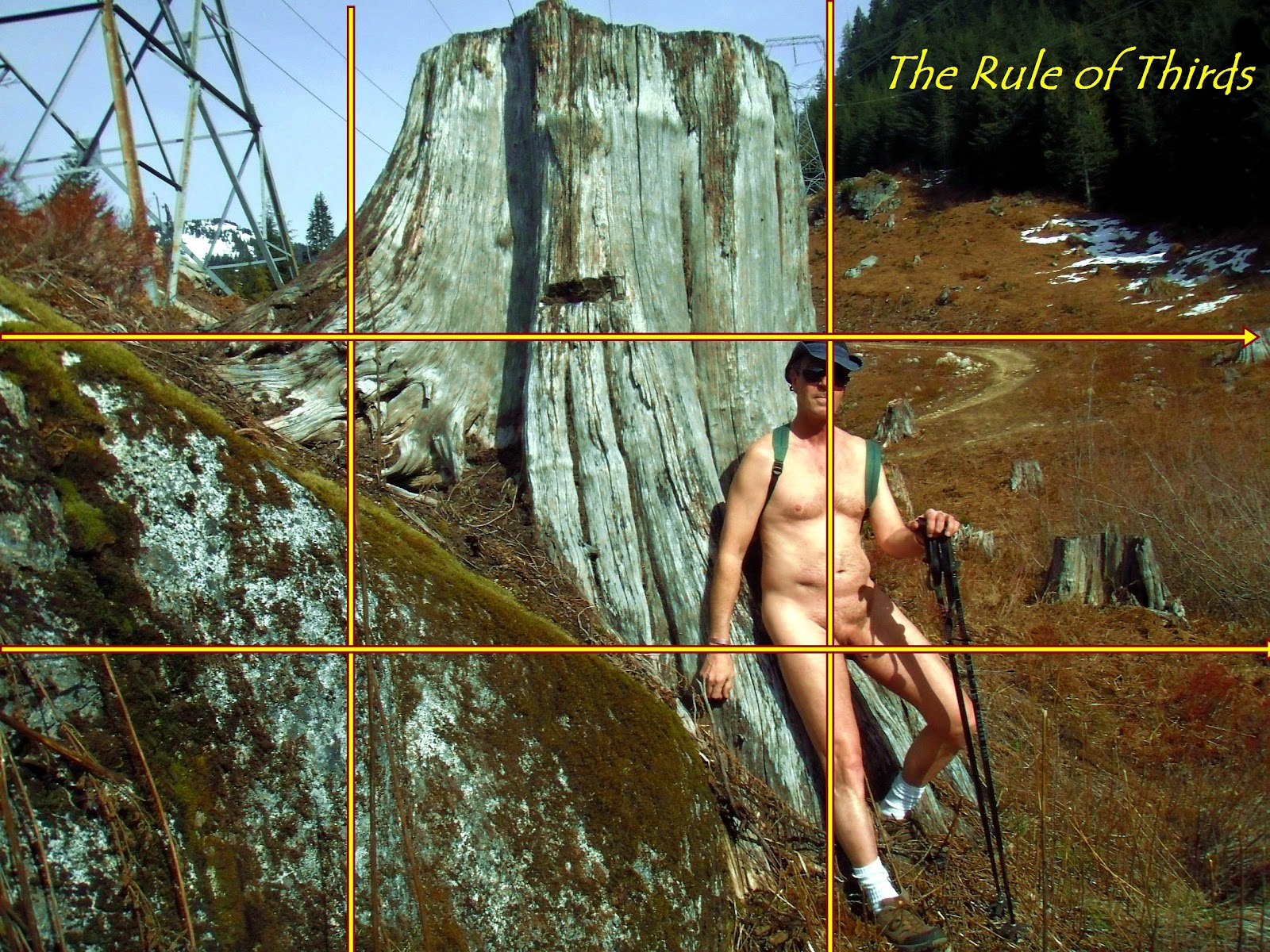
If we mentally cast a grid of thirds over a scene (my camera makes this easy as I can call up a grid in the viewfinder), we want to compose the important parts of our image at the intersections of the grid lines or on the grid lines, themselves.  In the image below, my head is two-thirds of the way up the image at the intersection of two grid lines.  The viewer's focus and attention are automatically going to be drawn to my head and then mentally form a response in relation to all the other elements in the image using that ratio of thirds.

Rule of Thirds
Note that a pleasing depiction of the human body in relation to the background will conform to the ratio of thirds.  Attention is drawn to the head at two-thirds of the way up.  The third above places the subject (myself).  The next third is the torso and the final continues and completes with the legs.  The axis of the body is also on a grid line, reinforcing the importance of the main subject  . . . in this case, I wanted to depict myself nude next to the stump of an old, massive and long-gone tree.

Placement of elements on the horizontal grid lines works well for horizons . . . in this case, the horizon beyond is all in the upper third . . . as is the majority of the tree stump.  The mind's eye is taken on a journey from the main subject and placed it in relation to the other important elements in the image.


So the Rule of Thirds in utter simplicity:  place your main subject off-center!


The Rule of Diagonals

Elements of your image trending diagonal (like a road or river . . . perhaps a line of trees) tend to lend energy to the imagery.  The image becomes more dynamic because the viewer is expecting action of some sort to go on.
Rule of Diagonals

Using the same image as before, the main subject is balanced by the Rule of Thirds.  But this image also contains a number of diagonals that impart a sense of tension in the image.  That tension is the terrain and there is an implied dynamism between nude hiker and steep slope.  Will he fall . . . or will he stay in place (note the set of the trekking poles reinforcing perceptions)?

To be effective, diagonals, when extended to the image edge, should be within 1/6 of the image corners (as shown in the image above.)  The dominant diagonal in this image is the slope of the large block of granite upon which the tree stump (and myself) hold against gravity.  My left knee is also crooked, bringing the thigh into alignment with the main diagonal.  The main subject, myself, is within one-sixth distance of a center diagonal.


Diverging and Leading Diagonals

Diverging Diagonals imply inclusion:  The tilt of the subject along with
 the lines of the boulders  frame the river beyond, including them
with the main subject

Leading Diagonals:  In this image, the subject (set back) is implied to be moving
 across the snowfield by the diagonal line of footprints leading back to the viewer.

To add dynamism to your images, place your subjects along some naturally-occurring diagonal.  Diagonals . . . particularly if they include the main subject . . . work really well if they lead to one of the corners of the image . . . a satisfying arrangement for the viewer's mind. (For another slant, take a look at the construction of the Golden Triangle further down to get an idea of the psychological processes that are operating here with diagonals.)


Lines of Perspective and Converging Diagonals

Diagonals impart action in an image.  Converging diagonals can also imply direction and perspective . . . a go hither implication.

Lines of Perspective

In this image the main subject's head (me, of course) is right at the intersection of two Golden Section lines (described in the next section).  These intersections, derived from the Golden Section ratio, assure attention from the viewer.  There is a slight twist of the torso and shoulders in the direction I am traveling.  I wanted to impart somewhat of a journey on ahead in pleasing surroundings.  Converging diagonals toward the open space of the sky give perspective and an implication of 'that's where I'm going'.  The diagonals come from the lines of the path edges and flow naturally to the far distance.  Tall trees in the upper portion of the image frame the sky of the horizon and the route beyond.

Look for these naturally-occurring lines in your images to reinforce the story you are telling.  Shift camera position slightly if necessary to use converging lines in the terrain to add perspective to your image.


The Golden Section
"A mathematical proportion where the ratio between a small section and a larger section is equal to the ratio between the larger section and both sections put together, approximately 1.6180339887..."

Certain points in a picture's composition automatically attract the viewer's attention.  Similarly, many natural and man-made objects with certain proportions (whether by chance or design) automatically please us.  Leonardo da Vinci investigated the principle that underlies our notions of beauty and harmony and called it the Golden Section.

The Golden Section (or Golden Mean) is the basis of the Rule of Thirds . . . the later being a simplification and easier to implement.  The intersection points for the Golden Section are 3/8s in and 3/8s up and down in the image.  I'll leave it up to you how to figure out the sweet spots when you're out on the field trying to compose an image.  Suffice it to say, the resulting grid looks as it does in the image below.  Points where lines intersect automatically draw attention . . . in this case, directly to the image of myself.

The Golden Section
Composition using the Golden Section ratio is difficult in the field but can be of considerable use after-the-case when cropping to bring the important parts of an image onto an nexus (or intersection point).  In the image above, there is implication of movement forward and to the right (raised foot taking a step).  The shadow line on the grass in the background also forms a diagonal, further reinforcing a perception of movement.  The effect is lost in the original image as objects to the right disrupt the diagonals and take away the dynamism of the image.  Cropping the image to remove extraneous detail moves the subject out of the Rule of Thirds and closer to the center of the image.  However, with a little judicious placement of the subject on a Golden Section nexus, balance is restored to the image.

Addendum:  To emphasize just how powerful the Golden Section intersections are, several readers have noted that their viewing of the above image seemed to unconsciously bring their initial attention to the area of my right hip.  I tried this on a few nudity-accepting acquaintances minus the grid and asked them, in all honesty, what part of my body did they seem to be drawn.  Mind you, these are people who have seen me nude before so there is no snapping of the viewer's attention to the obvious details of my nudity.  Five of five all stated the snap-response was to focus on the area near my right hip for a briefest moment, looking for something prominent there before correcting slightly upwards. The nexus of two Golden Section lines had drawn all five automatically.  Two of my unwitting test subjects also commented on the small log to the left, even though it was insignificant in the scheme of things . . . except that it also sits near an intersection of lines.

The eyes are drawn away  from the subject to the specks of light to the left
in the darkness  . . . a Golden Section intersection.   Though unintentional
 at the time, one wonders if those specks are some wild animal waiting
for dinner . . . an uneasy prospect!
The image above has the supposedly main subject (me) right in the center of the image . . . right where I just told you not to place your main subject.  So what's happening here?  Why do I include it?

Actually, the compositional elements of this image are complex.  Common sense tells us the nude hiker in the center must be the main subject (and that was the intention when I took the picture).  Serendipity at work.  There are some diagonals (the footpath and the darkness-bracketing line of the small tree) that enclose and direct attention.  There is also the stark contrast between flash-lit foreground and absolute darkness that further tell us who (or what) the main subject should be.  Yet our attention is not fully on the nude hiker.  It strays somewhat uneasily to the darkness.  Why?  Spend a little time just looking at the image.  Where do your eyes unconsciously go?  I'm willing to bet it's that lone tall plant sticking up into the darkness on the left.  And then your eyes search for meaning and latch onto the unusual . . . the set of what looks likes eyes out there.

This is a good example of the power of the Golden Section rule to grab and hold our attention.  The plant is right smack dab on the intersection of two of those lines.  Anything at those nexus points is going to grab the viewer's attention and this is what is happening here.


The Golden Triangle

The Golden Triangle adds an element of dynamism to the Golden Section rule by running diagonals to the intersecting points.  An offshoot of the Golden Section, the nexus points primarily attract the viewer's attention while the diagonals from those points extend attention along them.

The image below of me skinny-dipping in the Skykomish River is complicated by a lot of things taking place . . . cluttered.  My face (as well as my left hand) are right on the intersections of Golden Section Lines and thus, automatically attract attention.  But look at where the diagonals of a Golden Triangle flow . . . down my arms, framing my water-treading body in the lower triangle.  Attention is focused.  The final diagonal brings the foaming water to the right into harmony with the rest of the image.

The Golden Triangle

Constructing the Golden Triangle
.... from the Golden Section

Composition in the Field

It's obvious I take most of the images of myself using a self-timer.  This gives me time to frame the image and consider where I want to be for best composition.  I look through that viewfinder for lines and symmetry and mentally place myself where I think the Rule of Thirds will emphasize how I fit into the surroundings.

One of the things I try to do when composing an image, is to try to provide scale for the viewer to get an idea from the limited field of view in a photographic image . . . what the eyes are seeing.  An image is two-dimensional, yet what is being experienced is a three-dimensional panorama.  We must provide cues to the majestic scale of the forests and mountains to truly capture them.  The best way is to include yourself in the image not only to vet that participation but to also to give the viewer scale and enhance a 3D effect.

My presence gives scale and depth to the trees
on this low knoll overlooking Deception Creek

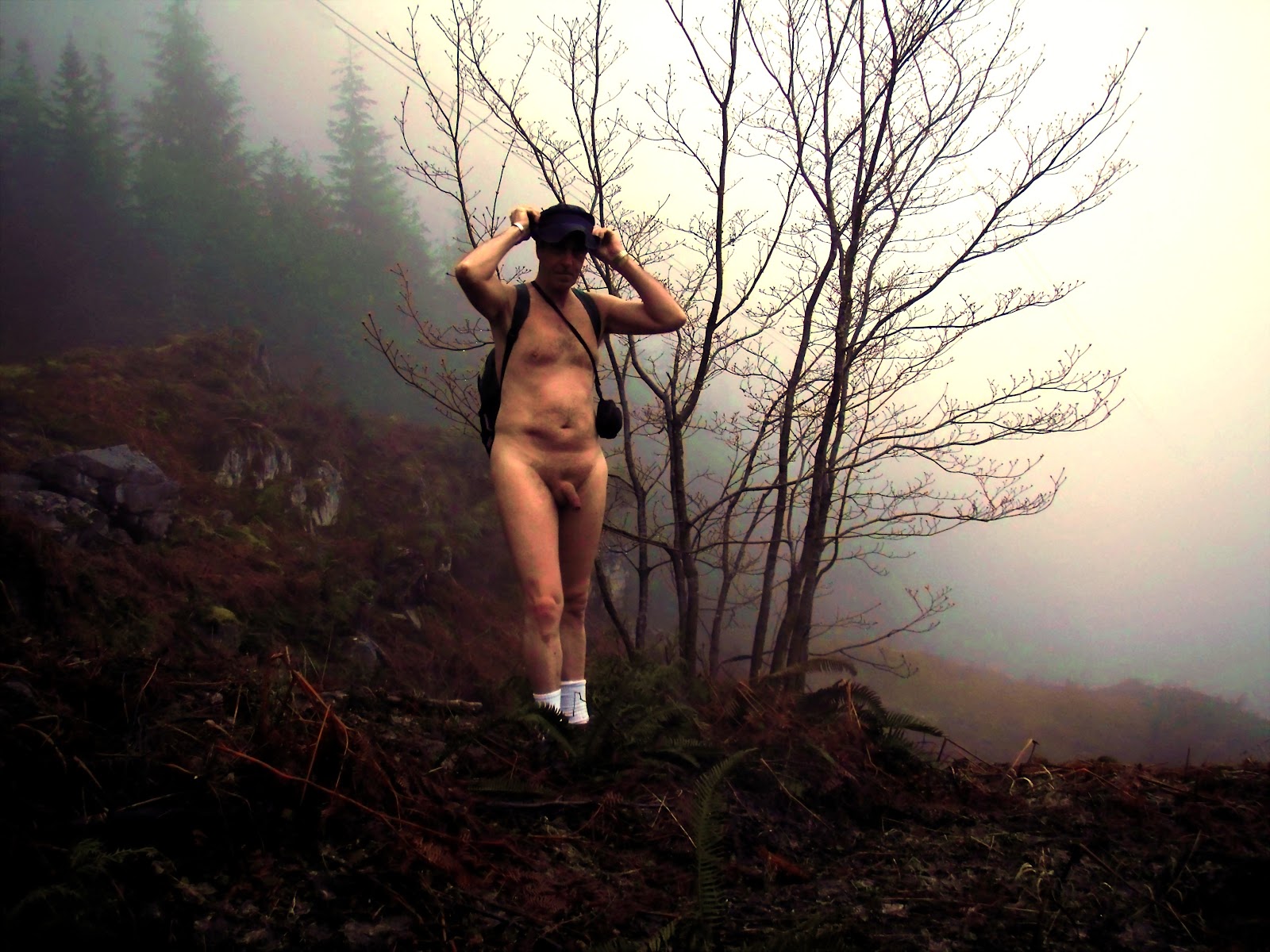
Another way to give the viewer an idea of the scale of the scenery is to use atmospheric cues such as fog.


The viewer's mind is always intrigued with figuring out what lays just beyond perception.  In the image above the fog does a remarkable amount of obscuring the trees in the upper left.  Our minds are going to be trying to pierce that veil trying to see through the fog . . . what does lay beyond?  Try it.  I challenge any reader to not honestly admit that they did not spend any time at all trying to pick out details in the background.

There is also an interplay of hard and soft contrasts in this image with the delineating line a diagonal crossing the image behind the main subject . . . the lone leafless tree in the center.  My presence provides the necessary scale and a contrast in color to make this image a keeper.

Try to avoid thinking of it as portrait photography because it isn't.  You are participating in nature and your images should show that participation.  You are, after all, trying to tell a story.

Final Thoughts 

  • There should be a center of interest or focus in the work, to prevent it becoming a pattern in itself;
  • The direction followed by the viewer's eye should lead the viewer's gaze around all elements in the work before leading out of the picture;
  • The subject should not be facing out of the image;
  • A moving subject should have space in front;
  • Exact bisections of the picture space should be avoided;
  • Small, high contrast, elements have as much impact as larger, duller elements;
  • The prominent subject should be off-center, unless a symmetrical or formal composition is desired, and can be balanced by smaller satellite elements
  • The horizon line should not divide the image in two equal parts but be positioned to emphasize either the sky or ground; showing more sky if it is of clouds, sun rise/set, and more ground if a landscape


Download the eBook of this post, 2.5M, pdf format for easy reading. Freely re-distributable under the Creative Commons License (Attrib NC ND)

Friday, October 8, 2010

Lower Lewis Creek, a State Park and Heybrook Lookout

Where Lewis Creek Meets the North Fork and a Delightful Little Park


Forks of the Sky State Park (in Trust)
Normally I don't go nude in State Parks because there is a prohibition against nudity in Washington State Parks.  State Parks also tend to be heavily used by the public.  However, there are some exceptions and a good example is the spate of acquisitions of private land by the state in the wake of record flooding in recent years.  This has led to a number of small-acreage areas being held in trust for further development.  They are relatively unknown, off the beaten path and lacking the amenities that typically attract the public.  The perfect opportunity for a short nude stroll in nature.

Forks of the Sky (where the North Fork and the South Fork of the Skykomish River come together near Index, WA) is one of those small acquisitions.  The ten or so acres used to be private property until the North Fork wiped out a major portion of the riverbank, along with cabins.  The state purchased the distressed property and then promptly forgot about it.  I'd seen the old, rusted sign and gate before but paid little attention . . . until I saw the new sign in the image above.  I wondered.

A week later I stopped by the small pullout on the Index-Galena Road.  No one else parked nearby.  Nude hiking time!  The old road down the the former cabin site is still there . . . grassy-green overgrown.  Years ago I'd wandered down that road out of curiosity . . . turning back after coming across a No Trespassing sign in sight of the small riverside cabin.  Now all that is gone as I come across a bridge that I recall from memory.

Across an old wooden bridge
The stroll is absolutely peaceful amid all the spaced trees draped in thick Cascadian moss.  The county road is not that far behind me but I doubt I would have heard much road noise from an infrequent passing car.  All I can hear is the twittering of leaves and critters going about their business in the undergrowth.  I'm impressed at how open and level the area is.

Across another bridge, this one a footbridge over a small streamlet of Lewis Creek . . . and soon I'm at the original cabin site, a wide area of low bluff open to the river.  Someone (I doubt the state) has carried in and put together a very nice picnic table.

On the original cabin site
The hike in had been short . . . ten minutes at most.  But I know this can't be all . . . so it's off to search for side trails and I soon find them . . . again, someone has gone to a lot of time and effort to improve the network of level, maintained trails in this potential park.  Originally I wondered if the paths might be loop trails and so proceeded with my senses spread out.  I tend to avoid loop trails or trails that have entrances at both ends.  Eventually it becomes obvious that this is not the case . . . the trails parallel the river north, and there is nothing north of this area but thick forest and creek bed wetlands . . .  until a sharp bend in the river a mile or so to the north.

Well-maintained, rock-lined trails and easy river access
This set-aside park land is not very big.  Within a short distance the trail becomes rougher and peters out to nothing but a mass of brambles and gullies that no nude hiker would want to traverse (except maybe me . . . but not today).  

There is a foot-worn earthen ramp leading down onto the river-rock boulders of the North Fork . . . the floodplain particularly wide here.  I'm still well short of that sharp bend in the river and visibility from the paved county road and an oft-used camping area.  I head out into sunshine and open air.  The occasional beer can or potato chip bag attests to others going on this way at other times.  But not today.  I have the open flats of the river bed to myself.

Onto the floodplain of the North Fork
I particularly like hiking in the open . . . being slightly claustrophobic.  Open spaces around me is what I crave.  River beds just naturally attract me and the river bed of the North Fork of the Skykomish (or more accurately, the floodplain caused by the seasonal rains and snowpack melt) is one of my favorite places to hike nude.  For the most part, the North Fork has little activity along its' bank until it meets up with the South Fork at Index.  A few cabins, but little of anything else to worry someone about being seen.

This river has a history of flooding wide in its' course . . . and during low water months that leaves lots of room to hike over smooth-water-worn boulders and numerous patches of givable sand to claim as your own personal beach.  But most of all . . . despite its' openness, there is a real sense of privacy out there.  My meanderings take me from the river's slow summer babbling, over multi-ton boulders worn baby-skin smooth to the forest edges . . . and back.  No where in particular . . .

Coming down the middle of the floodplain, I eventually realize that I've come just enough around a ninety-degree bend in the river to be visible to anyone travelling the Index-Galena Road in the distance.  The movement of a lone car heading north on that road catches my attention.  My valued privacy is now gone.

The campsite I'd mentioned earlier is on a twenty-foot high crumbling bluff just around that bend.  I head toward the inside of the bend and spot a very worn trail leading in.  Not sure if anyone is using the campsites but they've always been a favorite stopping off point in the past.  I've just never approached them from this direction before . . . and I'm still not sure if I can.  But we will see.  Up the banks, over a few downed trees and into the brush.

Enough scrambling and trail-making to find a back way into the
campsite.  Back to the open spaces of the river.
Unfortunately I didn't make it far in before I heard the unmistakable sounds of people having a good time just beyond the impenetrable barrier of intertwined brush and sharp alder branches.  Guess a stop at that campsite is out of the question.  Besides, those brittle, sharp twigs have already scratched up enough of my body.  Back to the river and safer, open spaces.


My own, private, wind-screened sandy beach
Coming back down the river I stick to the inside, closer to the banks and following a sandy, deep gorge created at some time by seasonal flooding, but now dry.  Some scrambling getting over flotsam and water-torn logs the diameter of city buses for another of my favorite activities . . . walking the downed tree trunks.  It's in these flood-eroded gorges that I find the most sand and sunning opportunities.  Following a dry-water course outward to the main channel I come across a really nice, deep patch of sand almost in the middle . . . and it's screened by a line of young alder saplings, almost as if by design.  A natural windbreak and privacy screen.  How can I resist not taking a break?  Plop down and off with the shoes for a nice nap.  It's quite some time before I decide I've dawdled enough.   This visit to a potential State Park was meant only to be a quick foray.  The main goal was to hike the road beside the upper Lewis Creek on up to Heybrook Ridge.  Back onto the well-maintained paths in the forest.


Barefoot in the Park
Hiking nude is freeing . . . natural . . . wonderful.  Hiking nude without even your shoes is . . . sublime.  I get few opportunities to do it barefoot in the Cascades . . . footwear almost always being a necessity to protect the feet.  Hiking back to my car with my shoes slung over my shoulders, the feel of years of overburden giving just so under the soles of my feet can only be described as sensuous.  Purists call it 'free-hiking' and it is definitely that.  Having to put my shoes back on was almost as if I was putting clothes back on.  Was I still nude?

Crossing that last footbridge a friendly dog came trotting on up . . . followed a moment later, before I could unsling and search for cover . . . by it's owner, a middle-aged lady seemingly out of place smoking a cigarette and carrying a beer amongst such serenity.  She kind of chuckled as she stood aside to let me pass and then we exchanged pleasantries on how nice this place was while her dog let me scratch him behind the ears.  All the time she kept on smoking away and sipping beer.  No backpack . . . just someone appearing out of nowhere.  Weird.  If  a naked man in the wild bothered her she didn't show any indication . . . which was a good sign and definitely gratifying.  Back at my car I continued to wonder where she had come from because there were no cars parked along the road for as far as I could see.  It was time to head a half mile down the road to the Lewis Creek trailhead.


Lewis Creek and on up to Heybrook Ridge and the Lookout Tower

Lewis Creek is a straightforward hike for me.  I've done it dozens of times because the road is gated, and the route in an easy-enough grade to really be enjoyable in it's solitude.  In winter this is a great place to showshoe, nude or otherwise.

For the most part it follows Lewis Creek in it's lower sections before switchbacking and climbing south onto Heybrook Ridge.  Heybrook Ridge overlooks Hwy 2 and the Skykomish River just east of Index.  The highlight of any trip onto Heybrook is a visit to the top of a decommissioned fire lookout tower.  The standard route up is via a mile and a half trail from Hwy 2 . . . my back route is almost three miles of time to myself.   Eventually you come onto the ridge, intersecting the FS road that used to service the tower (and is now a little-used logging road from the town of Baring further east on Hwy 2.


A photo moment approaching the ridge...
Serendipity sometimes gives the best results.  At first I was going to toss this image, as it wasn't what I intended.  Here I am adjusting the camera and the timer goes off too soon (or more likely I wasn't paying attention).  But I actually like this composition and proportions.  Goes to show . . . sometimes just leave it alone.

Just beyond the point above the road tees with the right heading to the lookout tower.  Once on the other dirt road I tread quietly because I never know if hikers have been coming up to the tower from the more traditional side of the ridge.  Sometimes they wander off to do some exploring of their own, and Heybrook is popular.  Today, it wasn't.

The Fire Lookout Tower atop Heybrook Ridge
While this Lookout Tower has been decommissioned for years (with the upper enclosure boarded and locked) the lower observation platform is open and accessible to the public.  Sturdy stairs safely take the visitor to the top were they can gaze out over miles of the Skykomish River Valley and especially the peaks of Mount Index and Persis, nearby.

The view from the top
(and the traditional trail below)
Once at the top of the lookout tower you pretty much can see and know everything that is happening around you.  My little nude platform . . . I'll see anyone approaching a very long time before they'll have any idea I'm up there staring down on them . . . let alone they know I'm nude.  Kind of empowering and relaxing at the same time.  You want to linger there and I've often thought 'what a great place to camp out overnight'.

No claustrophobia here
Eventually you have to give up the castle on the hill and head back down before nightfall . . . of course, timing it to milk the most of the daylight nude.

The appropriate ending of any hike is, of course,
a long soak in the hot springs

A photo album with more pics from this hike is here:
http://www.anthonians.org/forgotten_knot/9-4-2010_LowerLewisCreek/

Tuesday, October 5, 2010

Alpen Falls (a belated posting from May of this year)

Standing on the precipice of the roaring Alpen Falls
I hear bemoanings of "There ain't nowhere to hike nude" all the time yet if you just look around, there are all sorts of opportunities to shuck the clothes and enjoy nature somewhat on it's own terms. My visit to Alpen Falls (officially known as Alpine Falls on the map, but historically known as Alpen Falls . . . a long story of ethnic controversy from the 40s) began as a visit to Scenic Hot Springs on a needed check up of conditions, and turned into a day-long foray into seeking out where this or that pullout or dirt track went . . . the upshot, Alpen Falls on the Tye River, which you can hear from the highway . . . shows on the maps . . . but I never really knew how to get to them (or, actually, never invested the time . . . always bigger or better-known fish to catch). But Alpen Falls is an absolute gem in the Cascades . . . easily accessible yet almost completely unknown and unvisited. A nude hiker's chance to really enjoy the majesty of nature.

I could have spent all day exploring around the falls but the legs wanted stretching that only a distance-hike could provide . . . and that added the third segment of my day . . . the old logging road up the side of Captain's Point. Unfortunately, our fickle weather did not cooperate and when I see storm clouds piling up against the crest of the Cascades I know it is probably not a good idea to continue in the open.

Despite spending the majority of the day nude, since I still had daylight I did some more of that exploring at the lower elevations with a trek along the Tye River to L-Chute Falls. Not as robust as Alpen, there is something vital about feeling the unimaginable roar of water . . . about accepting the fine mist of spray on your body when you stand just a little too close. What can I say . . . how can you possibly enjoy and participate with what nature is displaying if your body is shielded with water-repellent clothes? It just feels oh-so-glorious to stand there and soak (literally) it all in.

Alpen Falls

I put together a photo album of this day of enjoyment (including a couple of videos of the falls in action). Hope you enjoy them. You can access the album here:

Sunday, October 3, 2010

Foss Moss: Nude Hiking in the Fall Colors

In search of a lost GeoCache
Autumn is a great time to hike nude with summer finally over (not that we had much of one), kids back in school and the mountains generally quiet . . . . and best of all, the bugs all gone!  And then we have the vivid colors to make any hike well-worthwhile.

And no, I didn't find my lost geocache, but more on that later.

Saturday, October 2, 2010

Fall Creek Nude Hike (from a reader)

I do like to hear reports from other people who enjoy being natural in nature so it was a pleasant moment to enjoy reading Shirley's report on a nude hike along Fall Creek near Eugene, Oregon.  I was even more plesantly surprised when she gave permission to post her report along with the photos.  As Shirley declares in her email . . . the hike make her 'top ten hike list' and I know exactly what she is feeling.  I thank you for sharing, Shirley.  I, too, love that picture of the morning fog.      Rick


Shirley's Fall Creek Nude Hike Report


Hearing that the weather was going to be in the 80’s I decided to try and steal another nude camping/hiking weekend.  I figured with schools having started the forests would be empty and hunters most likely not target practicing yet.

Arrived at an undeveloped campsite in the Fall Creek area outside Eugene/Springfield around 5 pm on Friday evening.  This location was a previous interpretive site used by schools in the past.  After a forest fire the place has seen no interpretive class type use that I could tell.  The paved parking area and fire pit left by previous users worked perfect for nude camping.

A full moon that weekend provided a spooky like evening ambience.  I almost expected “Big Foot” to walk up and ask for a cup of coffee. 

Oregon Fog


Woke up early Saturday morning to Oregon fog that only added to the experience.  Once the sun broke through the fog and I thought the trail would be drier I headed out for a hike.  Actually enjoyed a pot of coffee while using the “dry the trail” for an excuse to start later.  Usually I start a hike as early as possible so that I can assure myself that it is safe to hike nude.  So little traffic in the area had me feeling comfortable to hike/camp nude. 

I started my hike going up stream from a near by bridge.  At the bridge the trail crosses over the road to go down stream.  I have always wanted to check out some skinny dipping locations on Fall Creek so hiking the trail gave me a great opportunity to do so.  A portion of the hike was on an old road no longer used close to the river.   Left over fire pits from previous user groups shows that this area is a popular place.  Pleasantly surprised that I did not find any garbage or litter.  The trail is well used naturally maintained.


I hiked to a campground that has been closed for the winter months.  This past summer I only camped at a USFS campground one time this summer, as I am always able to find undeveloped sites for privacy.  Yes…I do feel like RV camping is not exactly “camping” so to speak.  J

Once at the campground I used an alternative trail to return to the bridge and cross the river to hike down stream.  There was one car parked at the bridge so I was more cautious about listening for noise. 

Hiking downstream I was no longer in the previously burned area.  What a drastic change.  Immediately I found myself in beautiful moss covered old growth trees and the trail decorated with ferns.  This trail is one of the most beautiful I have ever hiked.  Simply indescribable!  The trail is close to the river and the road on the right. 


Within minutes I could hear squealing and laughter that only a group of teenage girls make.  What a surprise to see them all on rocks jumping in the river and swimming.  Only kids swim in Oregon in late Sept.  The suits they were wearing did not seem to distract them from having a wonderful time.  I doubt they ever spotted me on the trail.

A short time later two men were fishing and if not for their dog would never have noticed me.  I had heard the dog and put on my long t-shirt.  They were friendly and I think one may have been nude previous to hearing me on the trail and the dog barking.

My intent was to hike to the first campground I came to.  I later made a decision to return back before reaching it.  The interesting thing about hiking trails is that returning back on the same trail and seeing it from a different direction is like hiking a new trail.

Interesting enough pretty much the only litter I found was close to where I had parked the RV.  Interesting litter in that it made it into my fridge.  A full unopened can of coke and two unopened cans of tomato juice with spicey flavoring!

Fall colors had started to change but not quite worthy yet of making a trip for fall color change only.


I love Oregon old growth forests and nude hiking!

Tuesday, September 7, 2010

Article: Healthy Sun Exposure

An interesting and informative article posted by KenFreehiker in the SkinnyTripper forum:


“. . . scientists have identified a total of nearly 3,000 genes that are upregulated by vitamin D. . . In recent years vitamin D has emerged as a star of the ‘vitamin’ world. For example, there are currently over 800 studies showing vitamin D’s effectiveness against cancer. Optimizing your vitamin D levels can literally cut your risk of several cancers by 50 percent! Further, middle aged and elderly people with high levels of vitamin D could reduce their chances of developing heart disease or diabetes by 43 percent.

Vitamin D is actually a ‘prohormone,’ which your body produces from cholesterol. Because it is a prohormone, vitamin D influences your entire body - receptors that respond to the vitamin have been found in almost every type of human cell, from your brain to your bones. So . . . vitamin D does more than just aid in the absorption of calcium and bone formation, it is also involved in multiple repair and maintenance functions, touches thousands of different genes, regulates your immune system, and much, much more.

Just one example of an important gene that vitamin D up-regulates is your ability to fight infections, as well as chronic inflammation. It produces over 200 anti microbial peptides, the most important of which is cathelicidin, a naturally occurring broad-spectrum antibiotic. This is one of the explanations for why it’s so effective against colds and influenza.

When you consider the fact that you only have about 25,000 genes in your body, and vitamin D has been shown to influence nearly 3,000 of them, the bigger picture of its true impact on your health can be easily understood. It may, in fact, have literally thousands of health benefits!

. . . Vitamin D deficiency is a growing epidemic across the world and is contributing to many chronic debilitating diseases.

. . . most people spend far too much time indoors during daytime hours. You may also have also been seriously misled by ‘expert’ recommendations to avoid all sun exposure, and to slather yourself with sunscreen whenever you do go outside. Please understand that sunscreen will virtually eliminate your body’s ability to produce any vitamin D because it blocks the UVB radiation that causes your skin to produce it naturally. As a result, in the United States the late winter average vitamin D is only about 15-18 ng/ml, which is considered a very serious deficiency state. In fact, new studies show that about 85 percent of the U.S. population is vitamin D deficient.

. . . 60 percent of patients with type 2 diabetes have vitamin D deficiency.

. . . It’s absolutely tragic that dermatologists and sunscreen manufacturers have done such a thorough job of deterring people from the sun - your optimal source for natural vitamin D.

Their widely dispersed message to avoid the sun as much as possible, combined with an overall cultural trend of spending more time indoors during both work and leisure time, has greatly contributed to the widespread vitamin D deficiency seen today - which in turn is fueling an astonishingly diverse array of common chronic diseases

. . . A study by Dr. William Grant, Ph.D., internationally recognized research scientist and vitamin D expert, found that about 30 percent of cancer deaths - which amounts to 2 million worldwide and 200,000 in the United States - could be prevented each year with higher levels of vitamin D.

. . . The optimal time to be in the sun for vitamin D production is as near to solar noon as possible. That would be between roughly 10:00am and 2:00pm.

. . . Most people with fair skin will produce the maximum amount of vitamin D in just 10-20 minutes, or, again, when your skin starts turning the lightest shade of pink. Some will need less, others more. The darker your skin, the longer exposure you will need to optimize your vitamin D production. African-Americans need perhaps 20 percent more sun exposure time than whites.

And contrary to popular opinion, your body simply cannot make adequate vitamin D from the sun unless you have more skin area exposed than just your face and hands. In fact, at least 40 percent of your body should be uncovered to optimize your vitamin D production.” – Dr. Mercola

Thursday, September 2, 2010

Grin and (Bear) It: Attempted West Cady Ridge Nude Hike

West Cady Ridge Trailhead
Saturday, August 28th, started out with grandiose plans . . . despite the less than stellar weather and the fact that it was a Saturday when the trails were bound to be busy.  Before I go any further, any chance to enjoy being outdoors, au' natural, in the beauty of the forests and mountains of the Cascades, is good.  However, this hike could have been so much more.

To start with I got a late start.  I had intended to hit my bank up as soon as they opened at 9am (ya need gas and coffee cash, after all).  At 8am the phone calls started.  deal with 'em.  Didn't get on the road until almost noon.  Still had to get some cash, fill up the gas tank and grab the obligatory coffee.  Once the essentials were out of the way it was time to strip down the the other barest essentials (a long tee shirt) and off to the mountains with less than grandiose plans of making Benchmark summit on the ridge.  Who would have though Monroe would be hosting the Evergreen State Fair this same weekend?  Fair traffic . . . took me an hour to inch through it to the last espresso stand in Goldbar and a chance that I was discreet and covered up enough (only had on a long tee shirt, remember?) 

I love to drive nude (or with as little clothing as appropriate).  It's an addictive sort of thing . . . the driving just so much more comfortable and giving a pre-taste of the kiss of sun on bare skin that you are seeking.  It took some time for me to get used to driving nude . . . a confidence sort of thing that if I couldn't see into the cars that were whizzing by, then neither could they have any real impression of my state or dress or undress as they passed me.  Nowadays I'm down to a lone tee shirt as I leave Seattle and lose that tee shirt once on the long stretches of Hwy 2 past Goldbar.  Nude time prolonged three or four hours longer.

Fresh coffee in hand and finally onto open highway one had to wonder about the gathering clouds over the Cascade crest.  Nonetheless, the weather held and even showed nice periods of sunshine as I drove the Beckler River Road just past Skykomish.

With the closure of the Index-Galena Road, the Beckler River Road via Jacks Pass is the only way to access the trailheads on the north segment of the loop.  The Beckler River Road (aka FS 65) is a nice asphalt-paved road for the first seven miles . . . passing a number of great undeveloped campsites by the river.  At the Rapid River junction the road becomes potholed gravel as it climbs toward Jacks Pass.  At the pass, right leads to Evergreen Mountain (the subject of a few of my other hikes), the hard switchback on the left goes up on San Juan Mountain and some great vistas over the North Fork valley.  The descending left goes over the pass and down into the North Fork Skykomish River valley.  That road is gated several miles into the valley at the top of the loop just after the turn for FS 63 and a number of trailheads, including Blanca Lake and  the triple one for Quartz Creek, Pass Creek and the West Cady Ridge trails.


It’s a Saturday . . . actually a perfect day for hiking (slightly on the cool side with the clouds keeping temperatures in the 60F range.)  Driving up the narrow gravel of FS 63 I almost decided it might not be a bad idea to at least put a tee shirt back on . . . what with the number of vehicles I met.  Halfway, at the Blanca Lake Trailhead spur, you might have thought they were having a convention.  Parking area overflowed and SUVs parked for several hundred feet in both directions along the shoulders (what little there was).  Glad I didn’t decide to try Blanca Lake but now I was wondering what the trailhead parking serving Quartz Creek, Pass Creek/NF Skykomish and the West Cady Ridge trails looked like.  Already my mind was going through the possible alternatives.

Fortunately that far trailhead was a little better . . . seven vehicles in the large gravel expanse of the parking area.  The conundrum with trailheads like this is that you really didn't know which trails the occupants of those vehicles choose to hike.  They could all be on the very trail I want to hike nude upon.

Short of the trailhead but in view a large gathering had set up campsite by the river and were attempting to see how much smoke their raging campfire could make.  Might explain why I never had a problem with gnats and mosquitoes as I usually do that close to the river.  Actually temperatures and the lateness of the season had a lot to do with the lack of pesky bugs.

The Forest Service also had four horse trailers parked short of the trailhead.  At first I thought they would be on the Quartz Creek trail but I later saw fresh, shod hoof prints on the lower West Cady trail.  Ah well, I'm here . . . the day is still nice . . . and there's no one around the actual trailhead.  Let's at least see how far hike nude.  I didn't have any allusions . . . this trail can be pretty busy despite it's difficulty and length . . . especially on weekends.  The one redeeming factor in favor of nude hikers is that you have great sight distance over a majority of the trail.  Th quiet of the airy canopy makes it easy to hear approaching hikers with plenty of advance time to make decisions.  The lower West Cadyblindspots over the ridge toes and curves.

So it was with reasonable confidence that I stayed nude, donned my pack . . . and headed off the wide open expanse of the parking area (before another car unexpectantly showed up) . . . and into the obscurity and quietness of the trail.  Though in diffuse shade and filtered sunlight, the temps were comfortable enough to hike.

The first segment of the West Cady Ridge trail parallels the river for a quarter mile or so before it comes around a bend to a well-made footbridge spanning a scenic gorge that the river has cut in the soft bedrock below.  Exposed as this location is (both to the Pass Creek trail diverging slightly above, and the first dog leg of the Cady Ridge trail onto Excelsior Mountain), it is well worth it to spend some time enjoying the deep glacier-green pools beneath the bridge where the river has been forced to scour into an abrupt 90 degree turn and change direction.  Just past the bridge is the formal boundary into the brand new Wild Sky Wilderness area.

The foortbridge over the NF Skykomish and the beginning of the trail
into the Wild Sky Wilderness
The lower portion of this trail was meant to be enjoyed with all the senses.  It is quiet . . . it is a melange of greens and earth-tone browns.  The trail is well-made and maintained . . . that in itself worth noticing and observing . . . especially since sooner or later we (those involved with Scenic Hot Springs) are going to have to do some major trail improvement at the springs.  This trail is properly cut a good eight inches to get below the overburden . . . which helps to insure the trail will not sprout new vegetation.

There has been a lot of consideration to snowmelt and rain runoff . . . both at the lower moderate slopes and higher up where the switchbacks are shorter to run the steepening sections to the ridge, proper.  I find myself stopping at each switchback and bend in the trail and studying how the runoff will be redirected to prevent trail erosion.

Well, that would teach me to pay attention to y wider surroundings because off the next switchback above this couple is descending at a brisk pace and I'm completely unaware until they are twenty feet away and greeting me.  If I'd been paying attention the bright colors of their Gortex and spandex outfits, along with the 'clunk-clunk' of fancy aluminum trekking poles, would have alerted me well in advance.  Grin and bare it, as they say.  No problems . . . we exchanged pleasantries . . . they'd been camping on the ridge and were now on their way back.  So much for being discreet on this popular trail, but 'no harm, no foul'.  The meeting had actual been quite pleasant and I was soon back to studying the construction of a puncheon bridge over a wetlands section.

Getting onto a trail late you eventually reach a point where meeting other users becomes problematic.  Day hikers would have already made the trek back down . . . or so it would be assumed.  First encounter . . . pleasant, so relax, let down the guard and enjoy the hike.

Sight distance back down the trail gives the advantage
to those on the high ground

The advantage on the trail goes to those who have the higher ground.  When we hike we watch the trail (and ground) in front of us . . . we do not look up.  Those on the trail higher up can see what is on the switchbacks below and that is where my next three companions come out off . . . just where the slope really steepens and the switchbacks do some innovative routing to gain elevation.  A blindspot that I knew was there yet made an assumption and ran into an elderly woman's trekking party working their way done at a brisk pace.  Nothing to do but courteously stand aside to allow them to pass.  No words exchanged but at least and couple of smiles and eye contact.  Okay . . .  two encounters . . . now I've go to have cleared the mountainside.  To bolster my experience, the kilt goes into the back pack . . . out of reach.

Grin and Bear it

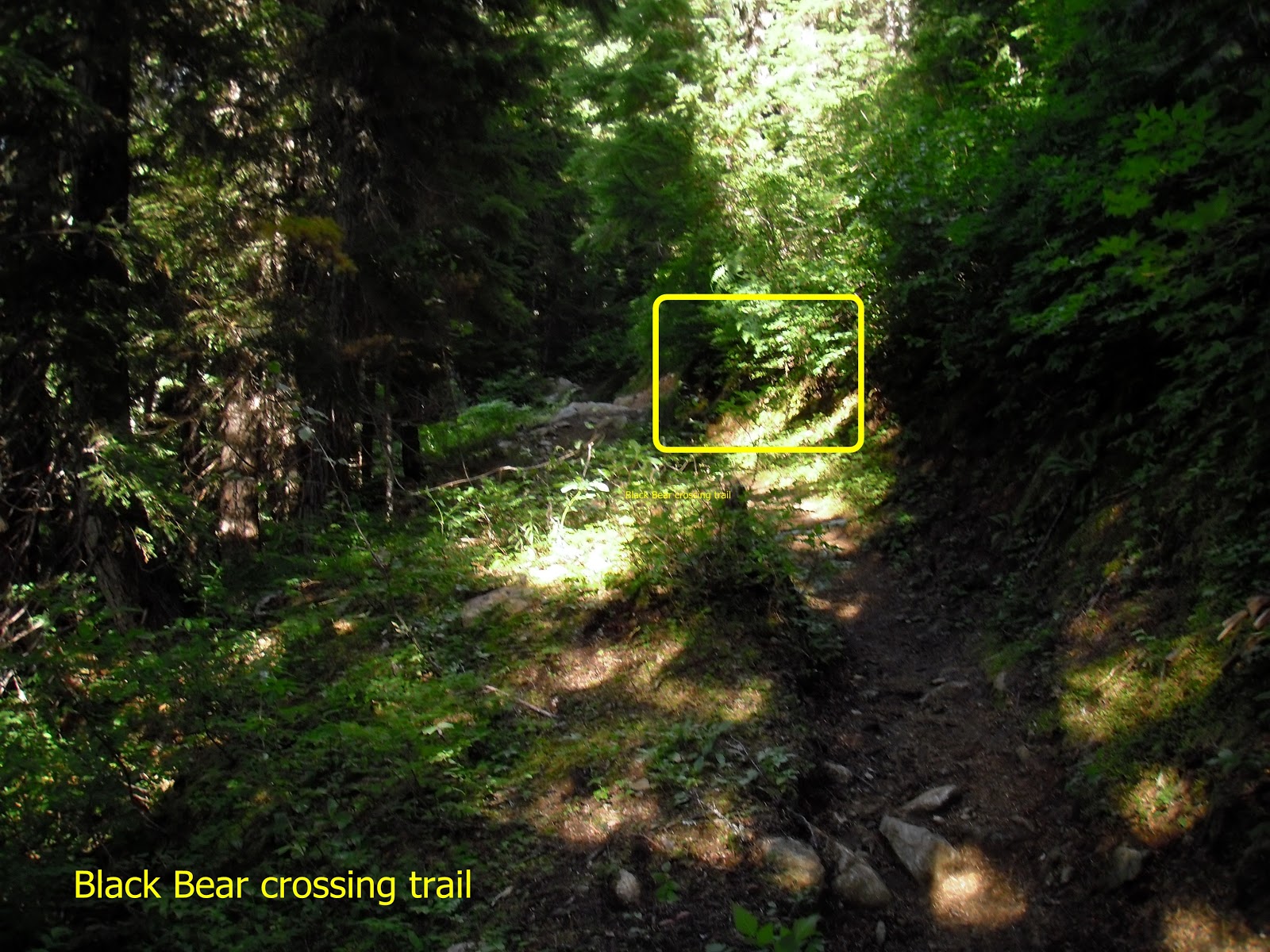
On the steeper sections as you gain the ridge, the trees thin and really open up . . . giving way to thick stands of huckleberries, mostly denuded of their fruit.  The switchback legs are only a few hundred feet in length before another unending change in direction upward.  I was just about to gain the open slope, proper (three more legs, if I remember correctly), when I caught a flash of jet black go right across the narrow trail fifty feet in front of me.  It's remarkable just how sensitive the human eye is to motion.  At that moment I hadn't been looking up the trail . . . instead checking the visible dog legs below.  Yet that momentary flash of black caught my attention and focus . . . long enough to make out the beautiful, furry shape of a yearling black bear who was totally unaware of my presence.

Black Bear on the trail
When I hike I don't make a lot of noise . . . mainly to allow myself to become immersed in the surroundings instead of intruding.  That may also allow me to hear oncoming hikers early but it is also a bad idea in bear country when you absolutely do not want to surprise a bear into defending itself.  Still, with the popularity of this trail the last thing I expected to come upon were bears.

It kind of startled me to stop.  The yearling had come from downslope and on off into the thick huckleberry bushes that hedged the trail very close.  I stood there listening and wondering where it had gone and whether I should go on or not.  I also had an overpowering urge to unsling my backpack and put on some clothes on the off-chance I got mauled by a bear.  Wouldn't do for the headlines to say, "Naked man attacked by a bear!"  Strange thoughts, I admit.

In any case, I wasn't going anywhere until I knew what the situation was.  I had bear spray and a couple of flares in my pack but not within easy reach.  I didn't feel in any immediate danger at the moment . . . simply a bear on the trail . . . unaware or ignoring me.  I powered up the camera and aimed up trail . . . just in time to catch a second yearling come bounding across a little bit further on.  I got it's picture just barely (pun definitely not intended.)

Bears are solitary creatures.  Two together . . . especially young ones . . . means momma is still in charge.  I was just about to ponder that little factoid in the pregnant stillness on that mountainside . . . was just about to retrieve my bear spray and have a flare at the ready . . . when a loud crash of what I can only surmise to be 'momma' came from just up above and behind me in the thick bushes.  Now I'm nervous.  I ain't continuing up that trail where two bears, still under their momma's protection, just bounded across ad if I weren't there . . . and not I'm doubly worried that momma might have cut off my escape route.

"Here bear" . . . "Hi bear", I sing-song.  My hiking staff taps nearby rocks and bushes.  Let 'momma' know I'm here.  I still the nervous knot . . . all my senses attuned to where the loud crash came from.  I have to will myself to turn and start slowly walking back the way I came . . . all the while talking to the unseen bears and making tapping noises with my inadequate staff.  I don't fully relax until I'm well off the steep sections and onto the longer switchbacks below.  By then I'm out of huckleberry territory and back into the airy canopy . . . not so hedged in.  Grin and Bear It!

The hike back out is perhaps the best part of any hike for me.  I thoroughly took my time and enjoyed every moment of freedom . . . even to the point of lingering in frequent patches of late afternoon sunshine to absorb the warmth and vitality through the pores of my skin.  If only the textile-impaired could experience these sensations . . . realize the skin is our largest sensory organ and should not be covered up.

By the time I crossed the footbridge over the NF Skykomish and ambled up into the now-empty trailhead I noticed the horse trailers were gone.  Though I'd seen fresh horseshoe prints on the trail they certainly didn't get by me so I have to assume they were later on one of the other trails . . . Quartz Creek.  Driving back . . . again without bother to put on anything . . . Blanca Lake was still packed with SUVs at it's trailhead.  The sun was going down so they'd better hustle.  The Blanca Lake trail in the dark is treacherous.

Post Hike Visit to Scenic

I often wish I could live as a full-time nudist but alas that's not reality.  So I'm never satisfied with my nude time.  I often prolong the experience after a hike by heading to Scenic Hot Springs for a soak and, in general, check for trespassers and conditions.  I've made it back to Hwy 2, resisting the urge to pull the tee shirt out of the back seat.  It's a silly sort of urge because I know that those oncoming cars cannot see into my vehicle to any real extent.  Driving nude down the highway is just absolutely comfortable and empowering.

At the gate to the springs there is a car parked.  On the dash is a note saying they have permission.  Well, possible . . . I'm not the only steward.  However, the sun is getting lower and the conditions we impose on access require all visitors be off the mountainside by nightfall.  Night soaking has been the main problem area that we are trying to address and correct.

So onward I go to see if they are heading back down.  My car can't make the rough road to the trailhead . . . I park in the clearcut and scan the far BPA road for signs of people.  The best location is by a BPA tower where I can see everything going on . . . and hang out basking in the waning sun.  I love the colors the late afternoon and dusk imbibe on everything they illuminate.  My favorite time of day for photography.

Watching the lightening storm while waiting

It's a little chilly out . . . a storm approaching.  I really don't feel like hiking the steep mile and a half up to the springs to kick someone out.  I really don't feel like dressing to counter the weather I know is coming.  As the landscape darkens with dusk I stand up at my perch beside the tower and watch the flashes of lightening on the east side of the Cascade crest.  Major thunderstorms there and the clouds are also building above the west side.  If I hiked up to the springs I'd want to do it nude . . . even in darkness.  However, if all hell broke loose . . . nah.  I don't want to pack rain gear and such.  I'll just wait for them to eventually come prancing on down.  I have a front seat view of a coming thunderstorm and the heater in my car, if need be.

Eventually, our overstepping guests come back down . . . ten thirty at night.  Well, I hope they enjoyed their soak.  And I've overstepped my endurance.  I follow them back out and secure the gate.  Time to drive home.

More images from this hike are in the JAlbum here.

Related Posts with Thumbnails